
Introduction
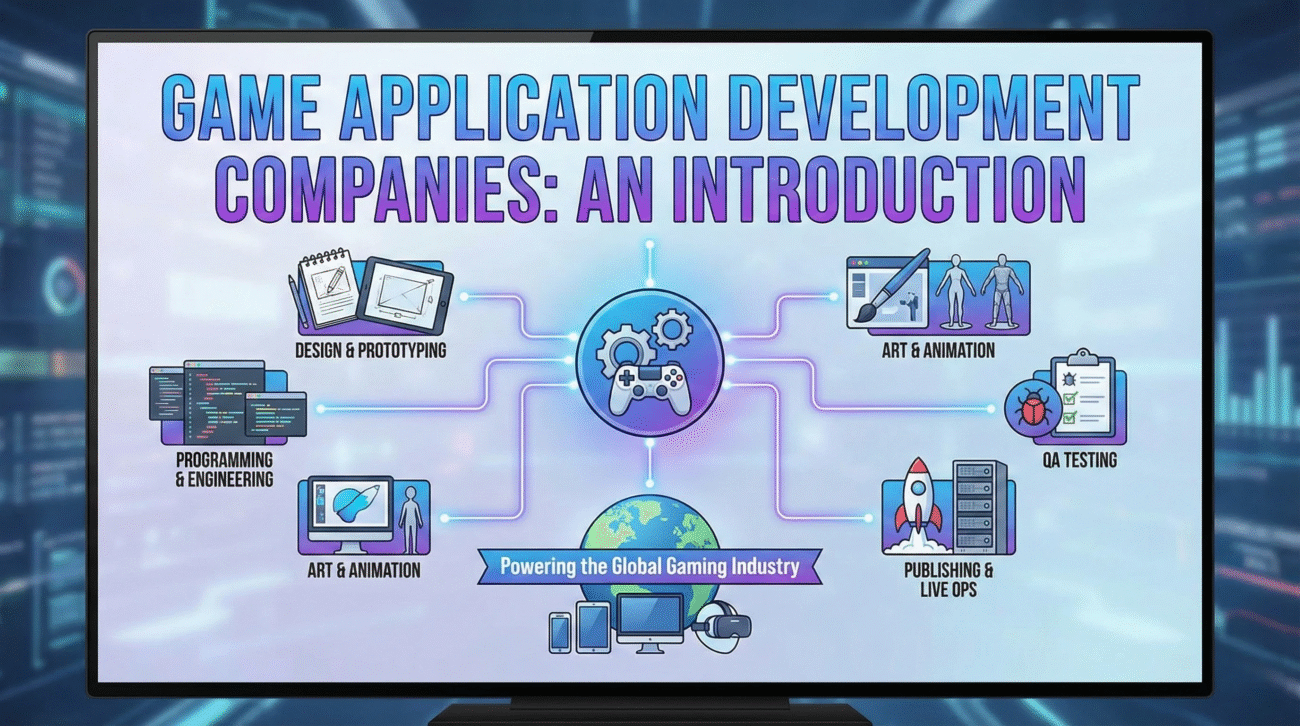
Game application development companies specialize in creating interactive digital games for mobile devices, PC, consoles, web browsers, and emerging platforms like VR and AR. These companies handle everything—from concept design, game mechanics, and UI/UX to coding, graphics, animations, sound effects, testing, monetization, and deployment.
They employ expert developers, designers, animators, storytellers, and testers who collaborate to deliver visually appealing, high-performance, and engaging gaming experiences.
Types of Games Developed by Game App Development Companies
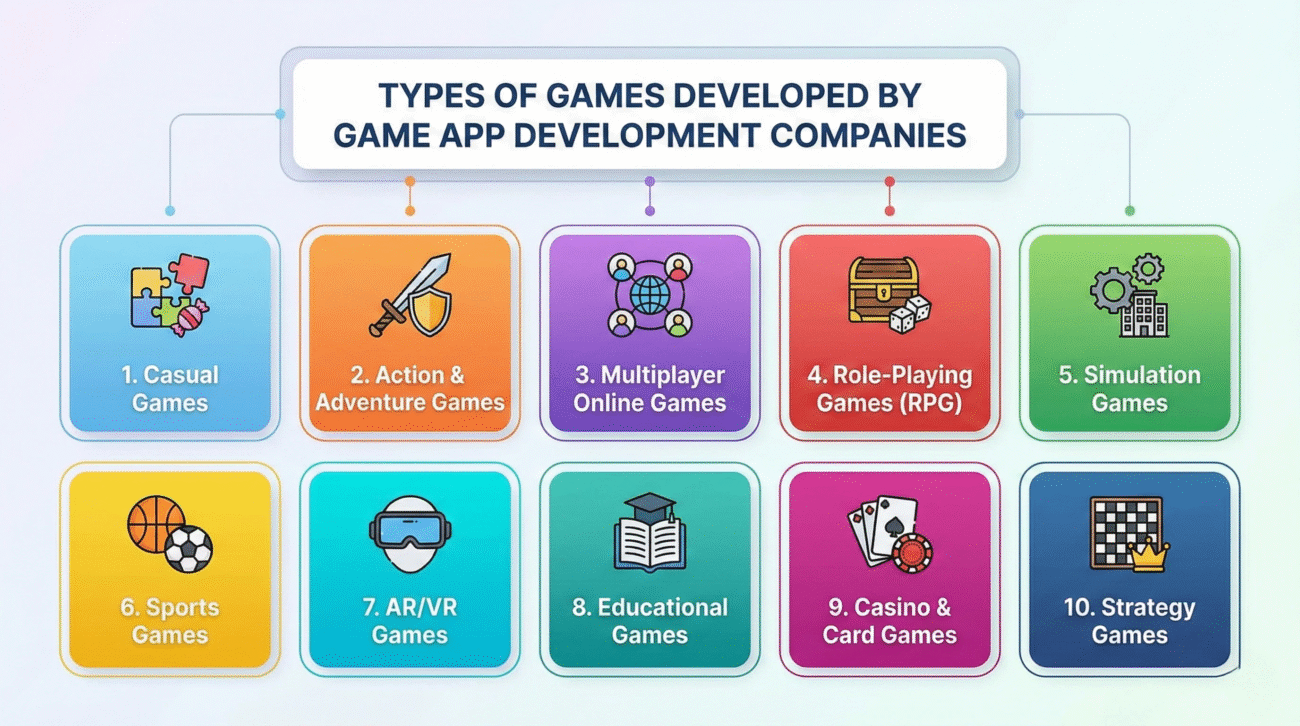
1. Casual Games
Casual games are simple, lightweight, and highly addictive, designed for quick entertainment without requiring long-term commitment. These include puzzle games, match-3 games, tap-and-play games, card puzzles, and quiz-style formats that rely on easy controls and short levels. Game development companies focus on smooth mechanics, colorful visuals, and engaging sound effects to make casual games appealing to all age groups. Their simplicity and quick gameplay loops make them ideal for mobile users and highly successful in app stores.
2. Action & Adventure Games
Action and adventure games offer fast-paced gameplay combined with missions, exploration, and combat-driven storylines. These games require advanced physics engines, dynamic environments, and real-time controls to deliver a thrilling experience to players. Developers create visually rich worlds, sophisticated enemies, and immersive story arcs that keep players engaged for long sessions. This category often includes superhero games, survival adventures, shooting games, and mission-based challenges that demand both skill and strategy.
3. Multiplayer Online Games
Multiplayer online games allow multiple players to interact, compete, or collaborate in real time. These include PvP battles, team-based challenges, and co-op missions that rely heavily on server connectivity and fast matchmaking systems. Game companies build robust backend architectures to support thousands of simultaneous players, ensuring smooth syncing, voice chat options, and leaderboards. With the rise of esports and online gaming communities, multiplayer games have become one of the most in-demand categories in modern game development.
4. Role-Playing Games (RPG)
Role-playing games immerse players in detailed storylines where they assume the role of a main character or hero. These games often feature magical worlds, leveling systems, skill upgrades, quests, and character customization options. Game development companies focus on creating deep story arcs, visually rich environments, and emotionally engaging characters. RPGs can be offline or online and are popular for their long-term progression systems that keep players invested for months or even years.
5. Simulation Games
Simulation games replicate real-world activities, allowing players to control or experience scenarios such as driving cars, flying planes, managing farms, running cities, or building virtual careers. These games require realistic physics, detailed environments, and accurate mechanics to deliver a true-to-life experience. Developers often integrate real-time management systems, resource planning, and customization options to make simulation games engaging and educational. This category appeals to users who enjoy creativity, planning, and open-ended gameplay.
6. Sports Games
Sports games include popular titles based on cricket, football, basketball, racing, baseball, and more. These games focus on realistic player movements, team mechanics, tournaments, and quick action-packed gameplay. Developers work on physics simulations, advanced animation systems, and responsive controls to mimic real-world sports experiences. Whether it’s a casual racing game or a full-fledged football league simulator, sports games attract a wide audience due to their competitive and skill-based nature.
7. AR/VR Games
AR/VR games use augmented and virtual reality to provide immersive, interactive experiences. AR games overlay digital elements on the real world through smartphone cameras, while VR games transport players into fully immersive 3D environments using devices like Oculus or PlayStation VR. Developers create intuitive controls, 360-degree worlds, and realistic interactions to enhance immersion. These games require advanced graphics, motion tracking, and spatial sound systems, making them perfect for futuristic, experiential gameplay.
8. Educational Games
Educational games are developed to teach skills, concepts, or subjects through interactive and entertaining activities. These games often include quizzes, puzzles, storytelling, and mini-games that help children and adults learn math, language, science, coding, and more. Development companies focus on creating child-friendly visuals, reward systems, and age-appropriate difficulty levels. Educational games are widely used in schools, learning apps, and parents seeking fun ways to boost their child’s learning.
9. Casino & Card Games
Casino and card games include poker, rummy, blackjack, slots, teen patti, roulette, and other gambling-style experiences. Developers integrate random number generators (RNG), secure payment systems, and user-friendly interfaces to provide a safe and fair gaming environment. These games may be based on virtual currencies or real-money gaming, depending on regulations. Casino games are extremely popular because of their simple mechanics, competitive tournaments, and reward-driven gameplay.
10. Strategy Games
Strategy games challenge players to think critically, plan ahead, and manage resources effectively. This category includes tower defense games, war simulations, empire-building games, and tactical combat scenarios. Developers create complex decision-making systems, AI opponents, detailed maps, and long-term progression mechanics to make gameplay intellectually engaging. Strategy games attract players who enjoy deep thinking, planning, and competitive challenges, making them popular across mobile, PC, and console platforms.
Top 10 Game Development Companies
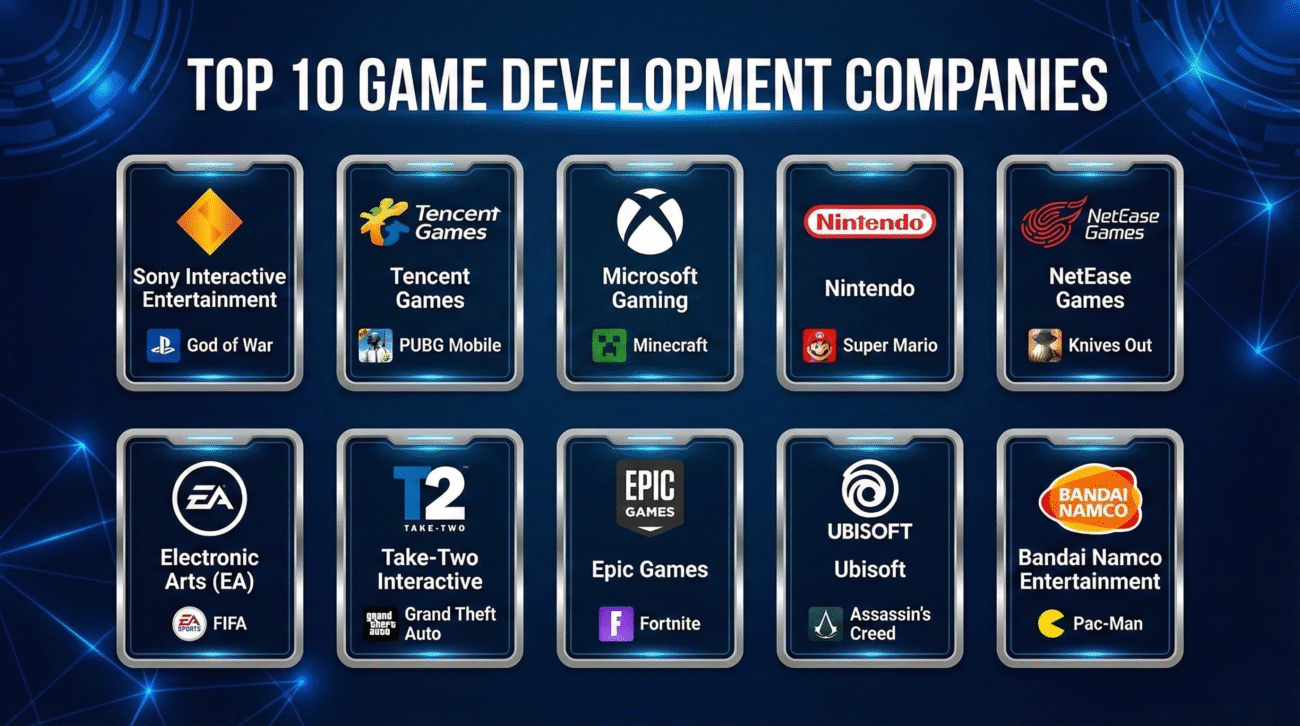
1. Unity Technologies
Unity Technologies is one of the leading forces in global game development, known for its powerful Unity engine used to build 2D, 3D, AR, and VR games across multiple devices. The company supports millions of developers worldwide and offers an advanced ecosystem of tools, assets, real-time rendering features, and performance optimization capabilities, making it the preferred choice for indie creators and large gaming studios alike.
2. Epic Games (Unreal Engine)
Epic Games is the creator of the Unreal Engine—one of the most powerful graphics engines used for developing high-end, AAA-quality games with lifelike visuals and cinematic effects. Their technology powers some of the industry’s biggest hits and allows developers to build cross-platform experiences with advanced physics, animation tools, and seamless performance. Epic Games is known for innovation and world-class development support.
3. Electronic Arts (EA Games)
Electronic Arts is a global leader in the gaming industry, responsible for many iconic franchises across consoles, PC, and mobile. With dedicated studios, advanced technology labs, and decades of experience, EA builds highly polished games with strong storytelling, engaging mechanics, and professional-grade gameplay. Their expertise covers everything from sports simulations and action titles to multiplayer online experiences.
4. Ubisoft
Ubisoft is a major game development and publishing powerhouse known for creating immersive open-world experiences and story-driven adventures. With studios operating across the globe, Ubisoft delivers high-quality games with cutting-edge graphics, deep gameplay systems, and memorable characters. Their development approach focuses on innovation, large-scale environments, and player engagement through continuous updates.
5. Nintendo
Nintendo is one of the most influential game development companies, known for its creativity, family-friendly titles, and timeless franchises. The company consistently delivers fun, accessible, and innovative gameplay experiences across handheld consoles, mobile apps, and Switch devices. Nintendo’s unique design philosophy and strong character-based storytelling have shaped the gaming industry for generations.
6. Rockstar Games
Rockstar Games is recognized for producing some of the most successful open-world games globally. Their titles are characterized by detailed environments, realistic mechanics, and cinematic storytelling that push the boundaries of modern game development. The company invests heavily in research, world-building, and immersive gameplay, making them a top-tier name in the gaming world.
7. Activision Blizzard
Activision Blizzard is a well-established studio known for its diverse portfolio of massively popular games. From multiplayer shooters to fantasy-based adventures, the company excels in creating dynamic, competitive, and engaging experiences. With a strong focus on esports, live events, and seasonal updates, Activision Blizzard continues to lead in community-driven and online multiplayer gaming.
8. Zynga
Zynga is a leading mobile and social game developer, known for creating easily accessible games enjoyed by millions. The company specializes in casual gaming, in-app monetization, and social features that encourage long-term engagement. Zynga’s expertise in user behavior, analytics, and mobile optimization has helped it maintain global popularity in the mobile gaming sector.
9. Gameloft
Gameloft is a pioneer in mobile game development, delivering high-quality games for smartphones, tablets, and smart devices. The company focuses on fast-paced gameplay, visually rich environments, and multiplayer options that enhance user engagement. With years of experience and a diverse library of titles, Gameloft remains a trusted name in mobile gaming worldwide.
10. Sony Interactive Entertainment
Sony Interactive Entertainment develops exclusive titles for PlayStation consoles and is known for producing cinematic, story-driven games with deep narratives and exceptional graphics. Their studios focus on innovation, character development, and advanced game physics that elevate the gaming experience. Sony continues to shape the future of console gaming with its cutting-edge technology and premium-quality releases.
Key Services Offered by Game App Development Companies
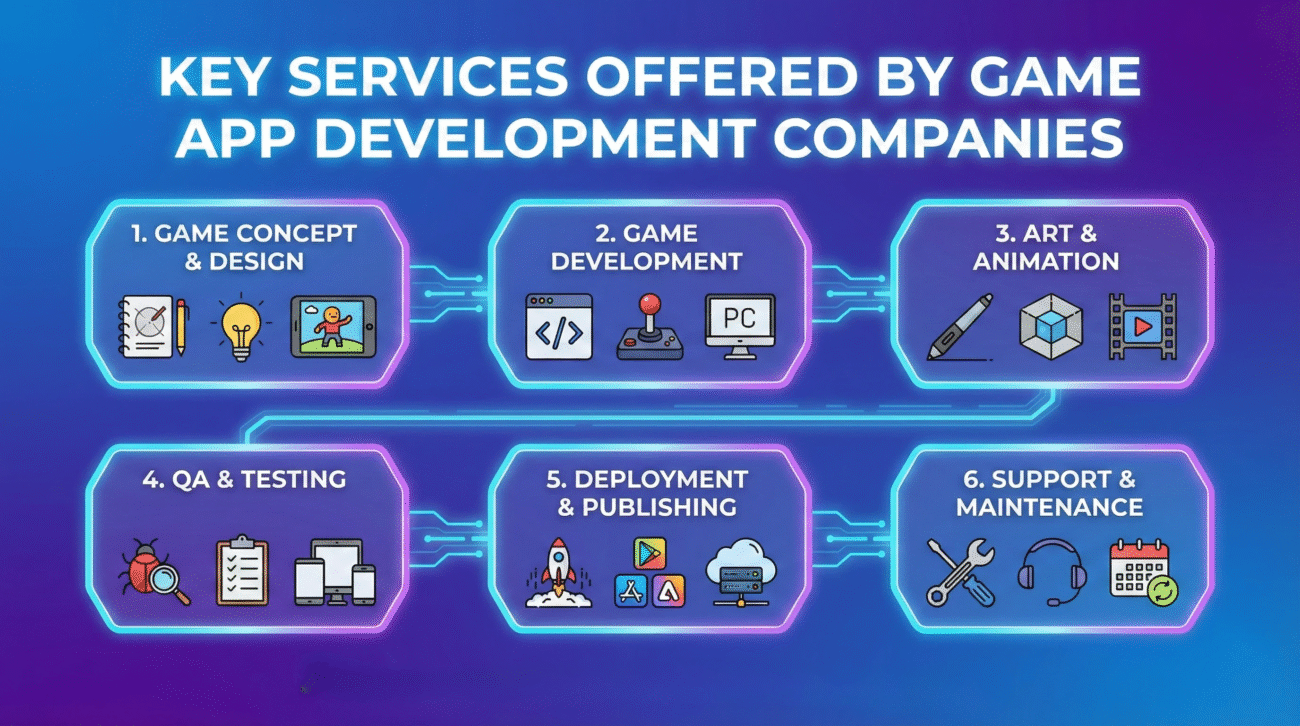
1. Game Concept & Story Development
Game development companies begin by refining the client’s raw idea into a fully structured game concept with clear objectives and engaging story elements. This includes defining characters, world-building, gameplay flow, mission structure, and narrative tone. Developers and creative writers collaborate to shape the core storyline, build captivating lore, and outline logical progression systems. This early phase ensures the game has a strong creative foundation before design and coding begin.
2. Game Design & Art Creation
The design phase involves creating visually appealing game elements such as characters, environments, weapons, items, and interfaces. Skilled designers craft detailed 2D and 3D models, animations, textures, backgrounds, and motion graphics that bring the game world to life. UI/UX designers also work on intuitive interfaces that enhance user experience and make gameplay feel smooth and interactive. High-quality art and visual design help the game stand out and attract players in a competitive market.
3. Game Development (Frontend + Backend)
Game development companies use powerful engines like Unity, Unreal Engine, and Godot to build robust gameplay systems and interactions. The frontend development focuses on visuals, controls, animations, and user interface, while backend development handles servers, databases, multiplayer logic, and cloud syncing. Developers also integrate physics engines, AI behavior, reward mechanisms, custom combat systems, and other features based on the game genre to ensure stable and immersive gameplay.
4. AR/VR Game Development
For immersive gaming experiences, companies create AR and VR-based games using technologies like ARKit, ARCore, Oculus SDK, HTC Vive, and PlayStation VR. These games require advanced 3D modeling, motion tracking, gesture recognition, and spatial audio to create highly realistic environments. AR/VR development focuses on creating interactive experiences that blend virtual elements with real-world surroundings or place players inside fully virtual spaces.
5. Cross-Platform Game Development
To maximize reach and reduce development time, companies build games that run seamlessly on multiple platforms, including Android, iOS, Windows, Mac, PlayStation, Xbox, and Nintendo Switch. Using cross-platform frameworks and engines, developers maintain a single codebase while ensuring optimized performance across all devices. This approach allows game studios to enter different markets without creating separate versions from scratch.
6. Game Testing & Quality Assurance
Testing is a critical service that ensures the game is stable, bug-free, and performs consistently across all devices. QA teams perform multiple types of testing, including functional testing, performance testing, compatibility testing, UI testing, multiplayer syncing, and stress testing under heavy load. Testers also identify glitches, lag issues, balancing problems, and gameplay errors. A thoroughly tested game leads to higher user satisfaction and better ratings.
7. Game Deployment & Launch Support
Once development and testing are complete, companies assist in publishing the game on platforms such as Google Play, Apple App Store, Steam, Epic Games Store, and various console marketplaces. They ensure the game meets all submission guidelines, handles app store compliance, and passes certification requirements. Launch support also includes preparing promotional materials, trailers, screenshots, and metadata for a successful game release.
8. Monetization Strategy Implementation
Game development companies integrate revenue models that help developers earn from their games without disrupting the player experience. Common monetization methods include in-app purchases, ads, rewarded video ads, battle passes, subscription plans, paid upgrades, and virtual currency systems. They also design reward loops and in-game economies that encourage spending naturally while maintaining game balance and fairness.
9. Post-Launch Support & Updates
After the game goes live, companies continue to support it through bug fixes, performance improvements, and regular updates. This includes adding new levels, characters, weapons, maps, seasonal events, and special challenges to keep players engaged. Post-launch maintenance also covers server monitoring, security enhancements, analytics tracking, and user feedback implementation. Continuous updates ensure the game stays relevant and maintains a strong player base over time.
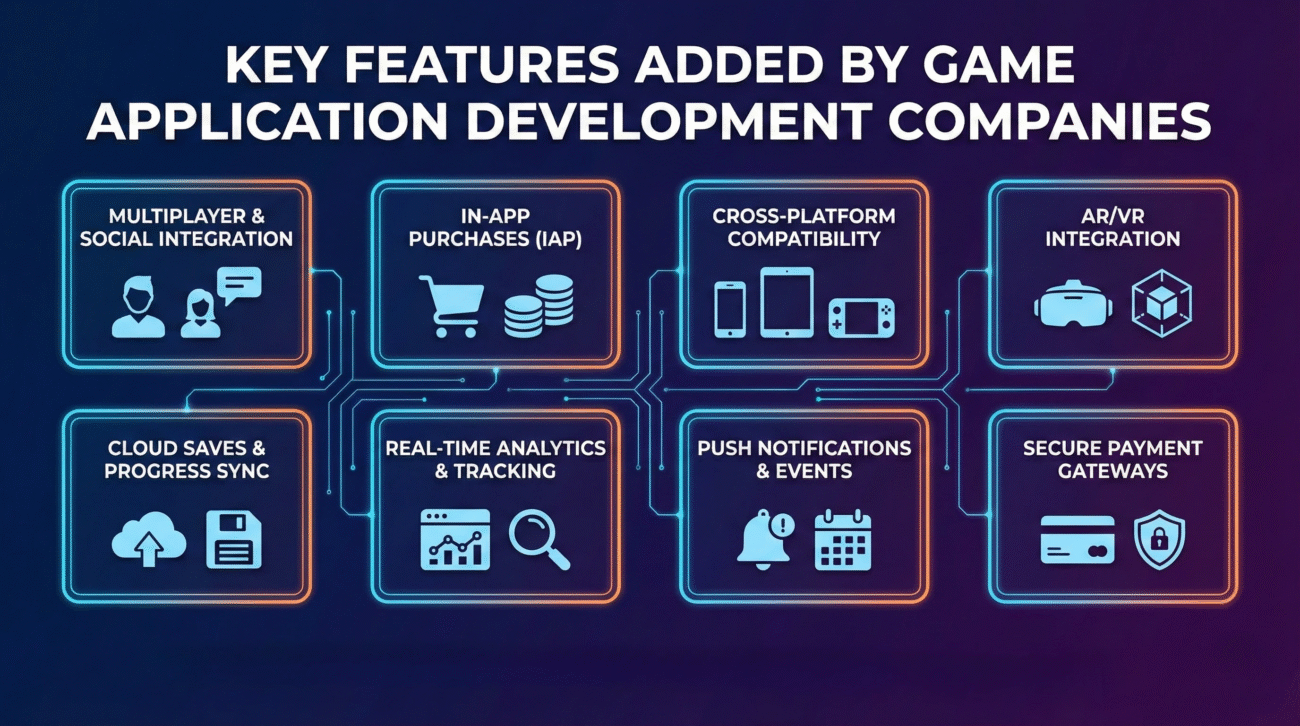
Key Features Added by Game Application Development Companies
1. High-Quality Graphics & Animations
Game development companies focus heavily on delivering stunning graphics and seamless animations that bring the game world to life. They use advanced engines and design tools to create detailed characters, smooth motion sequences, and visually rich environments. High-quality graphics not only attract players but also enhance immersion, making the gameplay more engaging and realistic across all devices.
2. Engaging Gameplay Mechanics
Strong gameplay mechanics are at the heart of every successful game, and development companies ensure that controls are responsive, actions feel natural, and levels are designed to challenge and reward players. They create balanced difficulty levels, intuitive controls, and exciting progression systems that motivate players to continue playing. These mechanics help establish a strong gameplay loop that keeps users hooked for longer durations.
3. Real-Time Multiplayer Systems
Many modern games rely on real-time multiplayer functionality, and companies integrate powerful systems that allow players to connect, compete, and collaborate instantly. These include matchmaking engines, live chat, friend lists, guild systems, and leaderboards. Developers also ensure smooth server communication and synchronization, enabling lag-free multiplayer experiences that support both casual and competitive gaming.
4. Cloud Integration
Cloud connectivity ensures that players can save their progress securely and access it from any device. Game development companies integrate cloud storage solutions that automatically back up game data, achievements, purchases, and player profiles. This feature improves user convenience, supports cross-device play, and adds long-term reliability to the game’s ecosystem.
5. In-Game Reward System
Reward systems are essential for enhancing engagement and keeping players motivated. Companies design in-game currencies, daily rewards, achievements, unlockable skins, badges, and bonus items that give players a sense of progression. These systems are built strategically to encourage repeat play, boost retention, and support monetization features like cosmetic purchases or premium upgrades.
6. AI-Based Controls & Opponents
Artificial intelligence plays a major role in shaping player experiences, especially in single-player and co-op games. Developers create AI-driven opponents, companions, and environmental behaviors that react intelligently to player actions. Whether it’s enemy combat patterns, pathfinding, or dynamic difficulty adjustments, AI enhances gameplay quality and makes challenges feel more natural and enjoyable.
7. Sound Effects & Background Music
Sound design is another critical feature added by game development companies to enhance immersion. They create high-quality sound effects for movements, collisions, dialogues, and environmental elements, along with background music that matches the game’s theme and mood. Professional audio engineering helps create an emotional connection and significantly improves the overall gaming experience.
8. Cross-Device Compatibility
To maximize reach, companies ensure that games work smoothly across multiple devices such as smartphones, tablets, desktops, and consoles. They optimize UI layouts, graphics performance, and input systems to suit different screen sizes and hardware specifications. This cross-compatibility allows players to enjoy a consistent experience regardless of the device they are using.
9. Performance Optimization
Performance optimization is crucial for delivering a smooth gaming experience, especially on devices with limited processing power. Developers focus on improving frame rates, reducing lag, optimizing memory usage, and minimizing load times. They also fine-tune assets and code to ensure stability across various network conditions, resulting in fast and fluid gameplay for all users.
10. Secure Payment Gateways
For games that include in-app purchases or subscription models, companies integrate secure and trusted payment systems. These gateways support credit cards, UPI, mobile wallets, and app store billing while ensuring data encryption and fraud prevention. Secure payment integration builds user trust and enables smooth monetization through in-game purchases, premium upgrades, and subscription services.
Why Choose a Professional Game Development Company?
1. Access to Skilled Designers, Developers, and Artists
A professional game development company brings together a team of experts including game designers, 2D/3D artists, animators, UI/UX designers, and skilled developers. This collective expertise ensures every aspect of the game—visuals, gameplay mechanics, sound, and performance—is developed with quality and precision. Instead of hiring freelancers separately, businesses get a complete team working in sync, which results in higher-quality games and faster delivery.
2. High-Quality Graphics and Smooth Performance
Professional developers use advanced tools like Unity, Unreal Engine, Blender, and Maya to create stunning graphics, realistic animations, and smooth gameplay. They optimize games for different devices to ensure low lag, fast loading, and stable performance. This level of polish is crucial in attracting players, improving user retention, and competing with top titles in the gaming market.
3. End-to-End Development Support
A dedicated game development company handles everything from initial idea creation to final app store deployment. They assist in concept designing, storyboarding, coding, art creation, testing, optimization, and launch support. This complete package eliminates the need for multiple vendors and ensures that the entire development process follows a consistent vision and professional workflow.
4. Advanced Tools and Latest Technology Integration
Professional companies stay updated with the newest gaming technologies such as AR/VR, AI opponents, cloud gaming, real-time multiplayer engines, virtual economies, and cross-platform frameworks. They can integrate these technologies into your game to deliver modern, high-performing gaming experiences that stand out in the competitive market.
5. Strong UI/UX and Engaging Game Design
Gaming companies understand the psychology of players and design UI/UX that is visually appealing, easy to use, and highly engaging. Whether it’s level progression, reward systems, controls, or menus, every element is planned carefully to keep players hooked. A good game design can make the difference between a user uninstalling the app in seconds or playing it for years.
6. Better Project Management and Timely Delivery
Professional companies follow structured development methods using Agile, Scrum, and milestone-based planning. This ensures clear timelines, regular updates, early prototypes, and smooth communication throughout the project. Their experience with multiple game launches helps avoid delays and ensures your game is delivered on time with all planned features.
7. Scalable Architecture for Long-Term Growth
A professionally built game can handle a growing number of players, data, and features over time. Skilled developers create scalable backends, cloud storage systems, and modular architectures that allow easy updates, new levels, seasonal events, and performance enhancements without rebuilding the entire game.
8. Reliable Testing and Quality Assurance
Game development companies perform rigorous testing to identify bugs, glitches, performance drops, and multiplayer sync issues. They test the game across different devices, screen sizes, and operating systems to ensure a flawless experience for all players. This reduces negative reviews, uninstall rates, and post-launch failures.
9. Post-Launch Support and Game Updates
Professional companies offer ongoing support even after the game is launched, including bug fixes, new updates, extra levels, seasonal events, UI enhancements, and performance optimization. Continuous support keeps the game fresh, attracts new players, and improves long-term user retention.
10. Effective Monetization Strategies
Companies integrate advanced monetization features such as in-app purchases, ads, subscriptions, virtual coins, battle passes, and premium features. They also guide clients on the best earning strategies based on the game genre and target audience. Proper monetization ensures long-term profitability and sustainable game growth.
11. Higher Chances of Market Success
With professional design, smooth gameplay, advanced features, proper testing, and strong monetization, your game has a significantly higher chance of performing well in the competitive gaming market. A development company brings industry experience, creative insights, and technical mastery needed to make your game stand out.
12. Compliance With App Store Guidelines
Game development companies ensure that your game meets all the technical and policy guidelines required by the App Store, Google Play, Steam, and console platforms. This reduces the risk of rejections, improves approval speed, and ensures a hassle-free launch process.
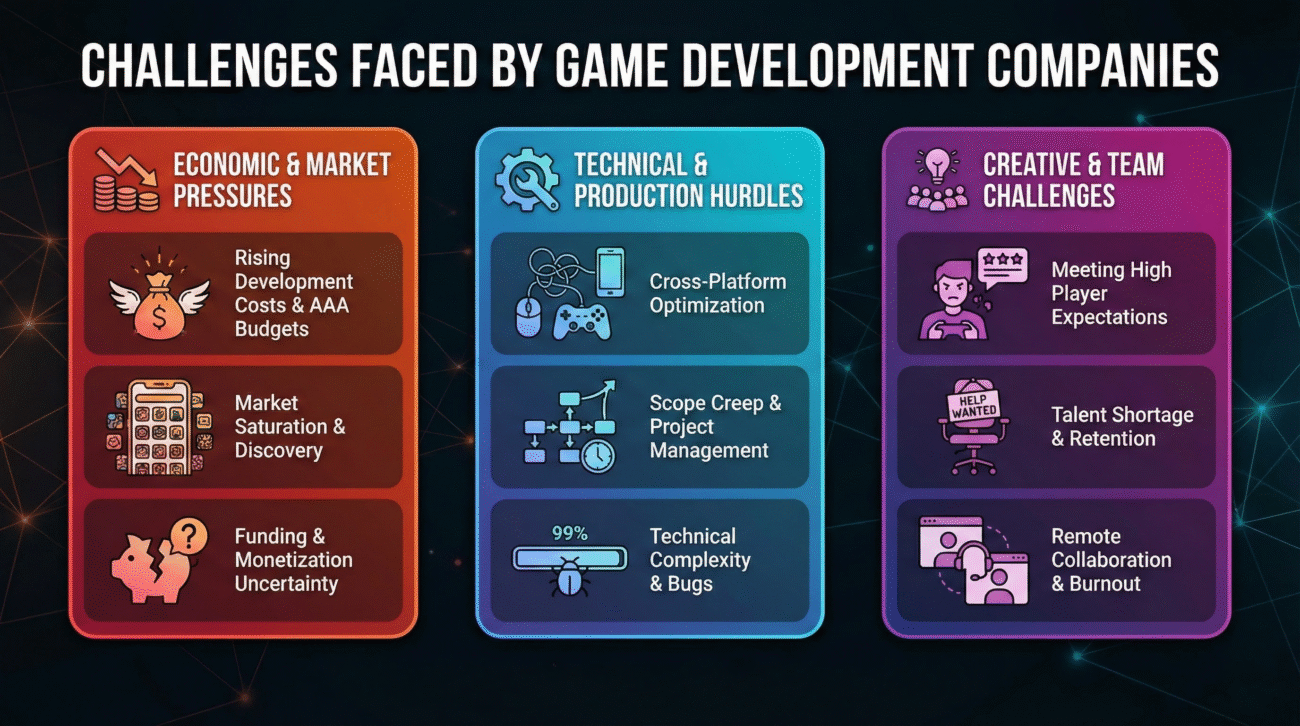
Challenges Faced by Game Development Companies
1. Maintaining High Performance Across Multiple Devices
One of the biggest challenges for game development companies is ensuring smooth performance on a wide range of devices, from low-end smartphones to high-powered gaming PCs. Developers must optimize graphics, reduce loading times, manage memory usage, and keep frame rates stable, which requires continuous testing and fine-tuning. Delivering a perfectly optimized game that works well for every user is complex, time-consuming, and technically demanding.
2. Balancing Graphics Quality with Gameplay Speed
Modern players expect realistic visuals, detailed 3D environments, and smooth animations. However, high-quality graphics can slow down gameplay if not optimized properly. Companies must find the right balance between visual fidelity and performance, ensuring the game remains attractive without affecting speed or responsiveness. This balancing act requires a combination of strong design skills and advanced optimization techniques.
3. Managing Complex Game Mechanics and Features
Games often involve complex systems like AI behavior, real-time physics, multiplayer functionality, and dynamic missions. Integrating these features without causing bugs or crashes is a major challenge. Developers must create stable code architectures, test every interaction, and ensure all game elements work together seamlessly, which can significantly extend development time.
4. Ensuring Bug-Free and Glitch-Free Experiences
Even small bugs or glitches can ruin the user experience and lead to negative reviews. Testing games thoroughly across different devices, screen sizes, and operating systems is extremely challenging. Companies need dedicated QA teams to detect issues early, simulate real user behavior, and ensure flawless gameplay before release. Achieving a completely stable product often requires multiple testing cycles.
5. Handling Real-Time Multiplayer Stability
Multiplayer games are highly popular but difficult to develop because they require stable servers, synchronized player movements, matchmaking systems, and anti-cheat mechanisms. Ensuring smooth, lag-free gameplay for thousands of players at once is technically complex. Any server delay or connection failure can instantly ruin the experience, making multiplayer development one of the toughest challenges.
6. Creating Engaging and Original Game Content
Standing out in a competitive market requires fresh ideas, creative mechanics, and memorable characters. Developing original content that keeps players entertained for long periods is challenging and requires strong creative teams. Companies also face pressure to create unique storylines, fun gameplay loops, and appealing designs that differentiate their games from the rest.
7. Meeting Tight Deadlines and Budget Limits
Game development projects often involve large teams, long production cycles, and high operational costs. Clients expect timely delivery, but complex game features can delay progress. Balancing creativity, quality, budget, and deadlines becomes one of the toughest management challenges. Companies need efficient planning and execution to prevent delays and cost overruns.
8. Supporting Future Updates and Continuous Content
Launching a game is only the beginning. Players expect regular updates, new levels, seasonal events, and performance improvements. Maintaining ongoing development while fixing bugs and adding fresh content requires an active team even after release. Keeping the game alive long-term is a major challenge, especially when the user base grows.
9. Protecting Games from Cheaters and Hackers
Security has become a huge concern, especially for multiplayer and reward-based games. Developers must protect in-game purchases, user accounts, scoreboards, and virtual items from cheating or hacking attempts. Building anti-cheat systems and encrypted gameplay logic requires specialized knowledge, and ongoing monitoring is essential to maintain fair play.
10. Competing in a Crowded Market
Millions of games are already available in app stores, making it difficult for new titles to get visibility. Companies face the challenge of not only building a great game but also marketing it effectively. Attracting players, retaining them, and generating revenue in a market dominated by established games requires strong branding, constant innovation, and smart business strategies.
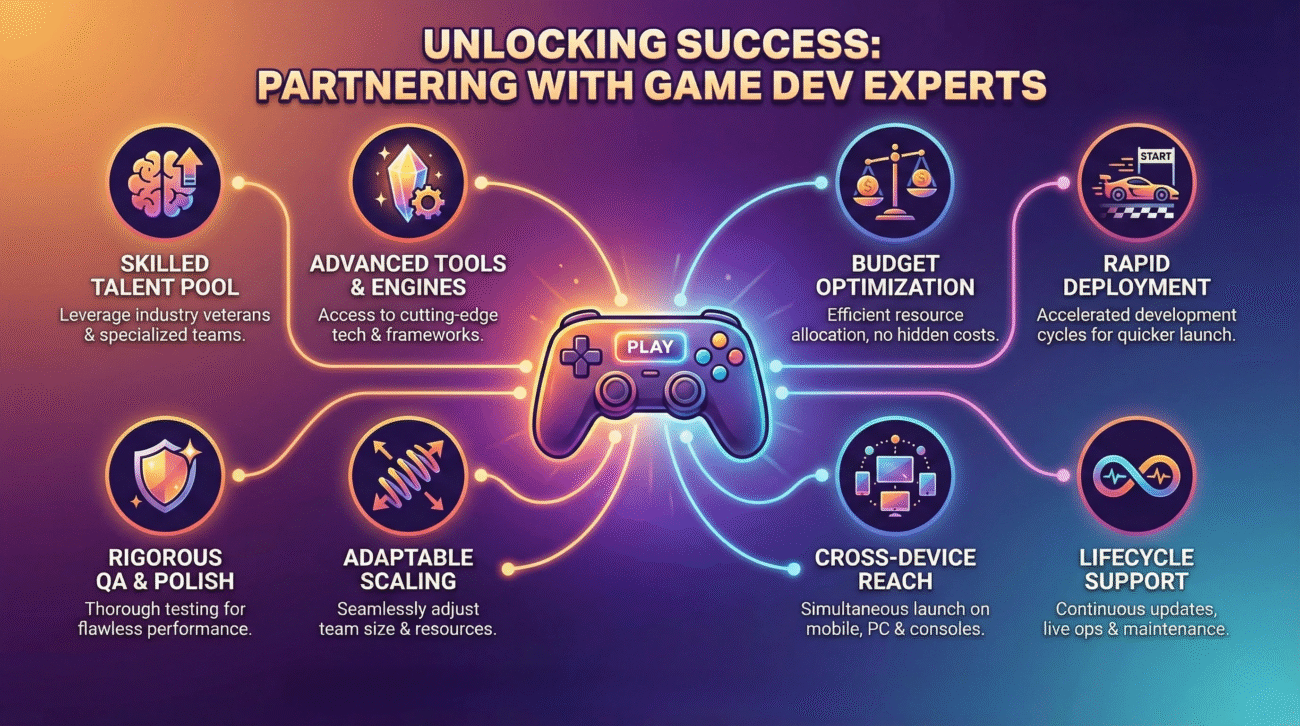
Benefits of Hiring a Game App Development Company
1. Professional Quality and Polished Output
Hiring a game app development company ensures that your project receives expert attention from experienced designers, animators, and developers. This results in high-quality graphics, smooth gameplay interactions, and optimized performance, making your game look and feel professional. Such polished output significantly improves user satisfaction and increases the chances of your game becoming popular in the market.
2. Faster Development with a Dedicated Team
A professional company provides a complete team working on your project simultaneously—game designers, programmers, artists, testers, and project managers. This parallel workflow drastically reduces development time compared to using freelancers or in-house teams. The company follows a structured timeline and delivers milestones on schedule, helping you launch your game faster.
3. Access to Premium Tools and Technologies
Game development companies have access to advanced tools like Unity, Unreal Engine, Blender, Maya, real-time multiplayer engines, and high-end testing devices. These tools allow them to build visually stunning games, realistic environments, and powerful mechanics that would otherwise be expensive or difficult to access for individual developers.
4. Reduced Risk and Better Problem Solving
Experienced companies have worked on multiple game genres, which allows them to predict potential challenges early. They can solve problems faster, avoid common mistakes, and handle technical complexities smoothly. This reduces the risk of delays, performance issues, or post-launch failures, ensuring a secure and stable development process.
5. Strong Post-Launch Support
Once the game is launched, you still need updates, bug fixes, seasonal events, new levels, and performance enhancements. Game app development companies offer ongoing maintenance services to keep the game fresh and relevant. Their long-term support ensures the game continues to attract players and maintain stability over time.
Top Features of a Good Game Development Team
1. Strong Creative Thinking and Storytelling Ability
A great game development team goes beyond coding—they craft compelling stories, engaging characters, and enjoyable gameplay loops. Their creativity helps bring unique concepts to life, making the game memorable and addictive for players.
2. Expertise in Multiple Game Genres
A good team is experienced in developing different types of games such as action, puzzle, simulation, RPG, sports, and multiplayer. Their versatility means they can adapt to your idea and build a strong gameplay foundation regardless of the genre you choose.
3. Technical Proficiency with Game Engines
The best teams are experts in leading engines like Unity and Unreal Engine. They know how to optimize performance, build smooth physics, integrate advanced graphics, and ensure stable multiplayer systems. Technical proficiency ensures your game runs efficiently on all devices.
4. Ability to Create High-Quality Graphics and Animations
A good development team includes skilled artists who can design characters, environments, effects, and animations that make the game visually impressive. High-quality visuals enhance user engagement and set your game apart from competitors.
5. Strong Testing and Quality Control Processes
A reliable team has dedicated QA testers who check for bugs, glitches, compatibility issues, and performance drops. They ensure the game runs flawlessly across different devices, screen sizes, and OS versions, leading to a better user experience and higher ratings after launch.
Conclusion
Game application development companies play a vital role in shaping the modern digital entertainment industry by turning creative ideas into fully functional, visually captivating, and immersive gaming experiences. With expertise across multiple genres, platforms, and technologies, these companies combine creativity with technical excellence to build games that engage players and perform consistently across devices. From concept development and design to coding, testing, deployment, and long-term updates, professional game developers manage every stage with precision and innovation. As gaming continues to evolve with advancements in AR/VR, AI, cloud gaming, and cross-platform connectivity, partnering with a skilled development company ensures your game remains relevant, competitive, and future-ready. In a fast-growing and highly competitive market, choosing the right game development partner can make all the difference in achieving success, scalability, and long-term player engagement.
Contact Us
We at ITech Solutions are always here to help you bring your ideas to life. Whether you have questions about our services or want to start a new project, we are ready to assist you with expert guidance and support.
Email: hr@itechs.co.in
Phone: +91-7976833560