
What Are E-Learning Applications?

E-learning applications are digital platforms designed to deliver educational content, lectures, courses, training programs, quizzes, and assessments online. They enable learners to study at their own pace, while teachers and trainers can track performance, share resources, and manage the learning process digitally.
These apps bridge the gap between traditional classroom learning and modern digital education, offering flexibility, interactivity, and scalability.
Types of E-Learning Applications
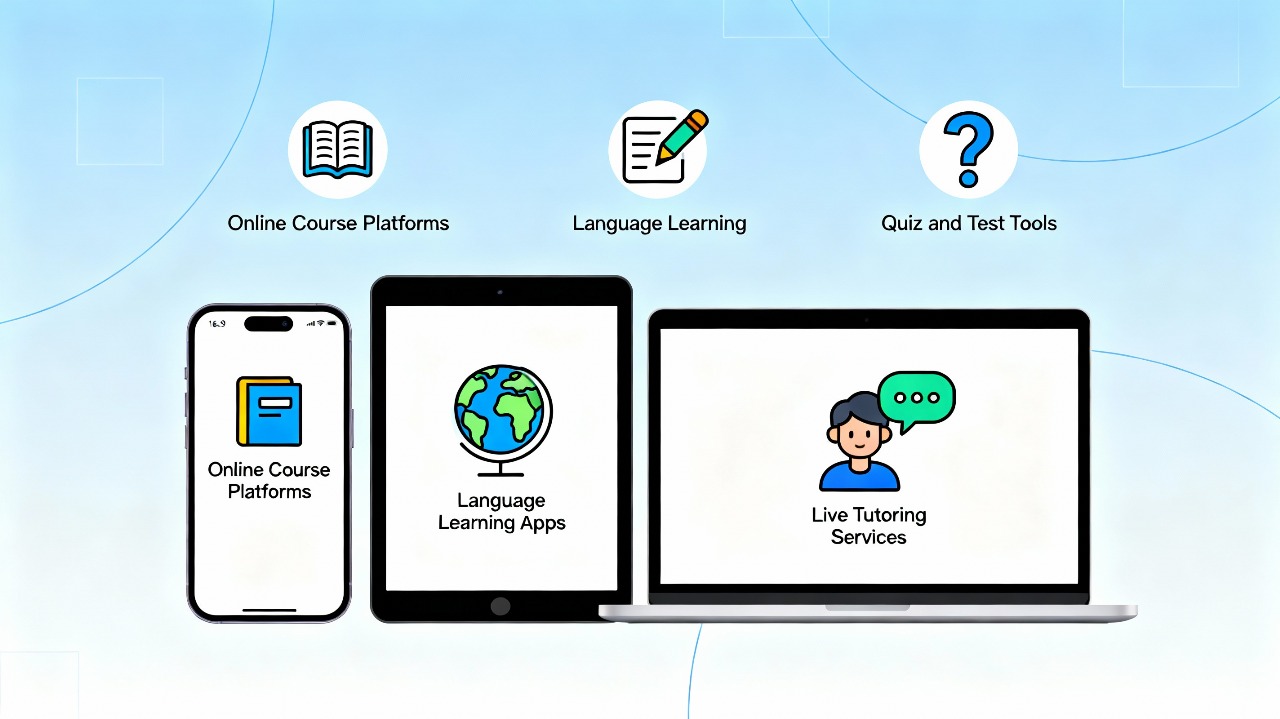
E-learning applications come in a wide variety of formats, each designed to cater to specific learning styles, goals, and audiences. These platforms have transformed traditional education by offering flexible, interactive, and scalable learning experiences. Below is a detailed explanation of the major types of e-learning applications used across schools, colleges, corporates, and individual learning environments.
1. Learning Management System (LMS) Apps
Learning Management System apps are centralized digital platforms used by schools, colleges, and corporate organizations to manage, deliver, and track learning. LMS platforms like Moodle, Canvas, Blackboard, and Google Classroom allow teachers or administrators to create courses, upload study materials, assign homework, conduct quizzes, and track student performance. They simplify communication between teachers and learners and provide structured dashboards for monitoring attendance, grades, and progress analytics. LMS apps are essential for institutions that require a controlled, organized environment for delivering online education and managing large batches of students.
2. Online Course & MOOC Apps
MOOC (Massive Open Online Courses) platforms such as Coursera, edX, Udemy, and Skillshare provide learners worldwide with access to professional courses taught by global instructors, universities, and industry experts. These apps offer video lessons, downloadable resources, interactive exercises, graded assignments, peer discussions, and completion certificates. Courses are available across multiple fields like technology, business, arts, fitness, finance, and personal development. The biggest advantage of MOOC apps is their scalability—they can teach millions of learners at the same time without geographical restrictions.
3. K-12 Learning Apps
K-12 learning apps focus on school-level education, providing chapter-wise lessons designed according to school syllabi. Platforms such as BYJU’S, Vedantu, Toppr, and Khan Academy use animations, interactive graphics, storytelling, and concept-based learning to make difficult subjects easier for children. These apps include live classes, practice questions, mock tests, doubt-solving features, gamification, and progress tracking. They help school students understand concepts better, prepare for exams, complete homework, and learn at their own pace from home.
4. Competitive Exam Preparation Apps
Competitive exam apps are developed specifically for students preparing for exams such as UPSC, NEET, JEE, SSC, Banking, GRE, IELTS, and CAT. Platforms like Unacademy, Testbook, Adda247, and Gradeup offer detailed study material, mock tests, timed quizzes, previous-year questions, doubt-solving sessions, live classes, and personalized study plans. These apps also track performance to highlight strong and weak areas. They provide structured guidance, expert mentorship, and targeted strategies to improve exam scores.
5. Language Learning Apps
Language learning apps such as Duolingo, Babbel, Memrise, Busuu, and Rosetta Stone help users learn new languages through gamified lessons, short exercises, pronunciation training, vocabulary drills, and real-life conversation practice. These apps offer micro-learning modules that require only a few minutes per day, making language learning consistent and enjoyable. Their reward systems, streaks, and levels keep learners motivated and encourage daily practice.
6. Skill-Development & Professional Training Apps
These apps target learners who want to upgrade their career skills or learn in-demand technologies. Platforms like LinkedIn Learning, Coursera Professional Certificates, Udacity, and Codecademy focus on skills such as coding, digital marketing, UI/UX design, AI, machine learning, finance, leadership, communication, and business management. They include hands-on assignments, capstone projects, downloadable resources, and industry-accepted certifications. Many of these apps partner with companies to provide job-focused training paths.
7. Corporate Training Apps
Corporate training applications are designed for businesses to train their employees in areas like compliance, onboarding, safety procedures, customer service, and leadership. These apps often include interactive modules, video training, assessments, and real-time analytics. Companies use platforms like SAP Litmos, Docebo, TalentLMS, and LearnUpon to streamline employee development and ensure consistent training quality across departments. Corporate training apps also help HR teams track progress, assign new learning materials, and evaluate skill growth.
8. Kids Learning Apps
Kids learning apps focus on early childhood development, offering fun and engaging educational activities for children aged 2 to 10. Apps like Khan Academy Kids, ABCmouse, Montessori-based apps, and LingoKids use colorful visuals, music, animated characters, puzzles, rhymes, and mini-games to teach basic concepts such as numbers, letters, shapes, colors, vocabulary, and logic. These apps support cognitive development, problem-solving, and creativity in young learners while keeping them entertained.
9. Virtual Classroom Apps
Virtual classroom applications enable real-time interactive learning through live video lectures, screen sharing, breakout rooms, digital whiteboards, polls, and chat tools. Platforms such as Zoom for Education, Microsoft Teams, Webex, and Google Meet help teachers conduct online classes similar to physical classrooms. Students can ask questions, collaborate with peers, participate in group activities, and attend interactive sessions from anywhere. Virtual classroom apps became essential during remote learning and continue to support hybrid education formats.
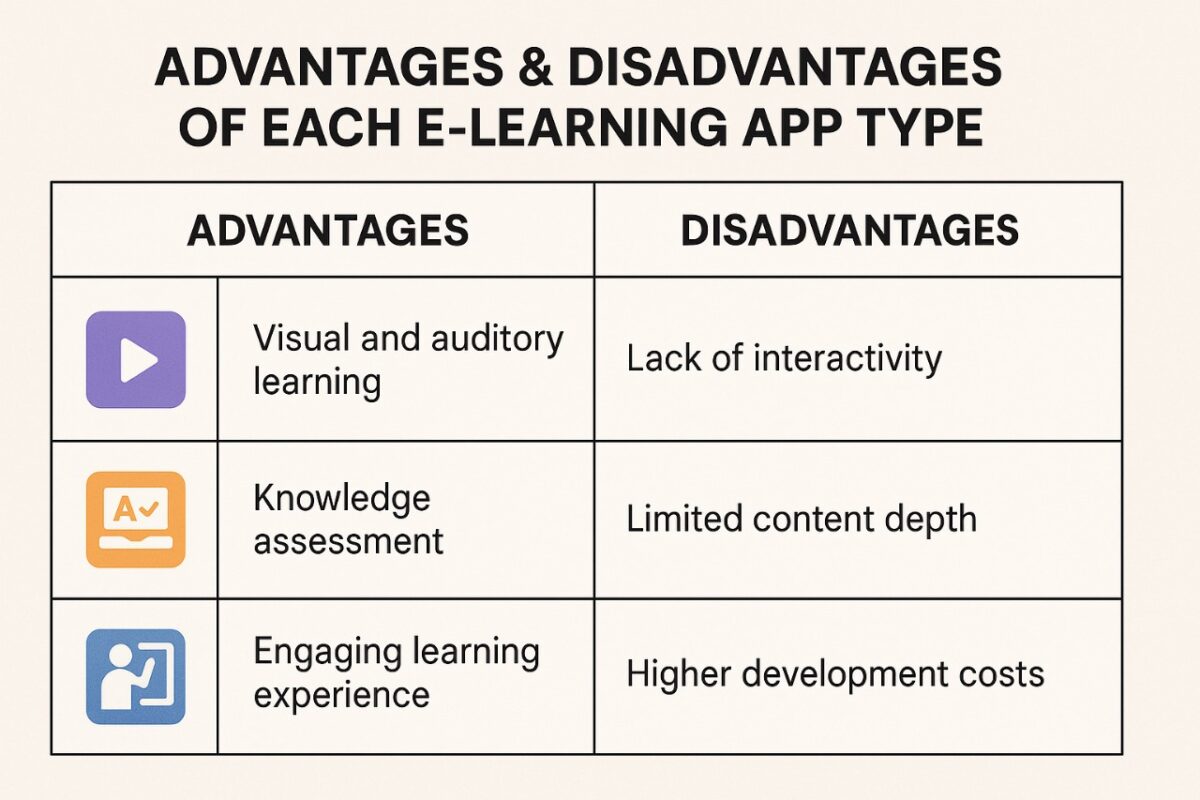
Advantages & Disadvantages of Each E-Learning App Type
1. Learning Management System (LMS) Apps
Advantages
Centralized platform for managing courses, assignments, and evaluations.
Highly organized structure ideal for schools, universities, and corporates.
Supports continuous tracking of learner performance through analytics.
Reduces manual work for educators and increases efficiency.
Encourages blended learning (online + offline).
Disadvantages
Can feel rigid due to structured course formats.
Requires initial setup time and teacher training.
Limited personalization unless integrated with AI tools.
May not engage younger learners without added interactive content.
2. Online Course & MOOC Apps
Advantages
Provides global access to top-tier instructors and universities.
Offers flexible learning with self-paced courses.
Huge variety across skills, industries, and career paths.
Includes certification that adds career value.
Scales to millions of learners at once.
Disadvantages
Low student completion rates due to lack of supervision.
High-quality courses may be expensive.
Limited personal interaction with instructors.
Not suitable for learners who need real-time guidance.
3. K-12 Learning Apps
Advantages
Engaging animations and storytelling help simplify tough topics.
Suitable for all grade levels with chapter-wise content.
Boosts student interest, retention, and conceptual clarity.
Provides personalized learning paths based on student performance.
Supports parents with progress insights.
Disadvantages
Excessive screen time may affect young learners.
Some apps are subscription-heavy.
Live classes may lack the emotional connection of a real classroom.
Can create dependence on digital learning instead of self-study.
4. Competitive Exam Preparation Apps
Advantages
Offers structured study plans, mock tests, PYQs, and leaderboards.
Live classes from experts improve understanding and speed.
Helps track weak areas and improve accuracy.
Community-based learning boosts motivation.
Available 24/7, ideal for exam aspirants.
Disadvantages
Quality can vary across educators.
May lack personal mentorship for deeper guidance.
Requires strong internet for live sessions.
Some platforms offer too much content, causing confusion.
5. Language Learning Apps
Advantages
Gamified lessons make learning fun and addictive.
Easy to practice daily with short modules.
Supports pronunciation and accent training with AI.
Covers vocabulary, grammar, speaking, and reading.
Affordable compared to offline classes.
Disadvantages
Cannot fully replace real-life conversation practice.
May not teach advanced grammar deeply.
Gamification may become repetitive over time.
Requires daily consistency for progress.
6. Skill-Development & Professional Training Apps
Advantages
Teaches in-demand industry skills like coding, design, AI, marketing.
Career-oriented projects and certificates improve employability.
Suitable for students, professionals, and job seekers.
Includes real-world assignments and portfolio-building tasks.
Disadvantages
High-quality programs can be expensive.
Learners need self-discipline without strict deadlines.
Some courses become outdated due to rapid tech changes.
Hands-on mentorship may be limited in some apps.
7. Corporate Training Apps
Advantages
Streamlines employee onboarding, compliance training, and development.
Tracks employee performance, progress, and certifications.
Saves companies huge costs on seminars and workshops.
Improves productivity and skill levels within organizations.
Ensures consistent training across teams and locations.
Disadvantages
Requires organizational commitment and implementation effort.
Employees may find digital training less engaging than physical sessions.
Custom content creation can be expensive.
Data privacy becomes a major responsibility.
8. Kids Learning Apps
Advantages
Highly engaging visual content keeps kids attentive.
Helps with early cognitive development and creativity.
Offers activity-based learning through games, music, and stories.
Supports parents in homeschooling and early education.
Builds foundational skills like math, language, and logic.
Disadvantages
Overuse may lead to screen addiction.
Parents need to supervise to ensure quality learning.
Not all apps follow a scientifically approved curriculum.
Lack of social interaction compared to physical preschool.
9. Virtual Classroom Apps
Advantages
Enables real-time learning with live instructor interaction.
Supports whiteboards, polls, chat, and breakout rooms.
Ideal for remote education or hybrid learning setups.
Encourages classroom-like collaboration and discussion.
Simple to implement for teachers and institutions.
Disadvantages
Depends on strong internet connectivity.
Technical glitches may disrupt classes.
Limited emotional connection compared to physical classrooms.
Harder for teachers to monitor student attentiveness
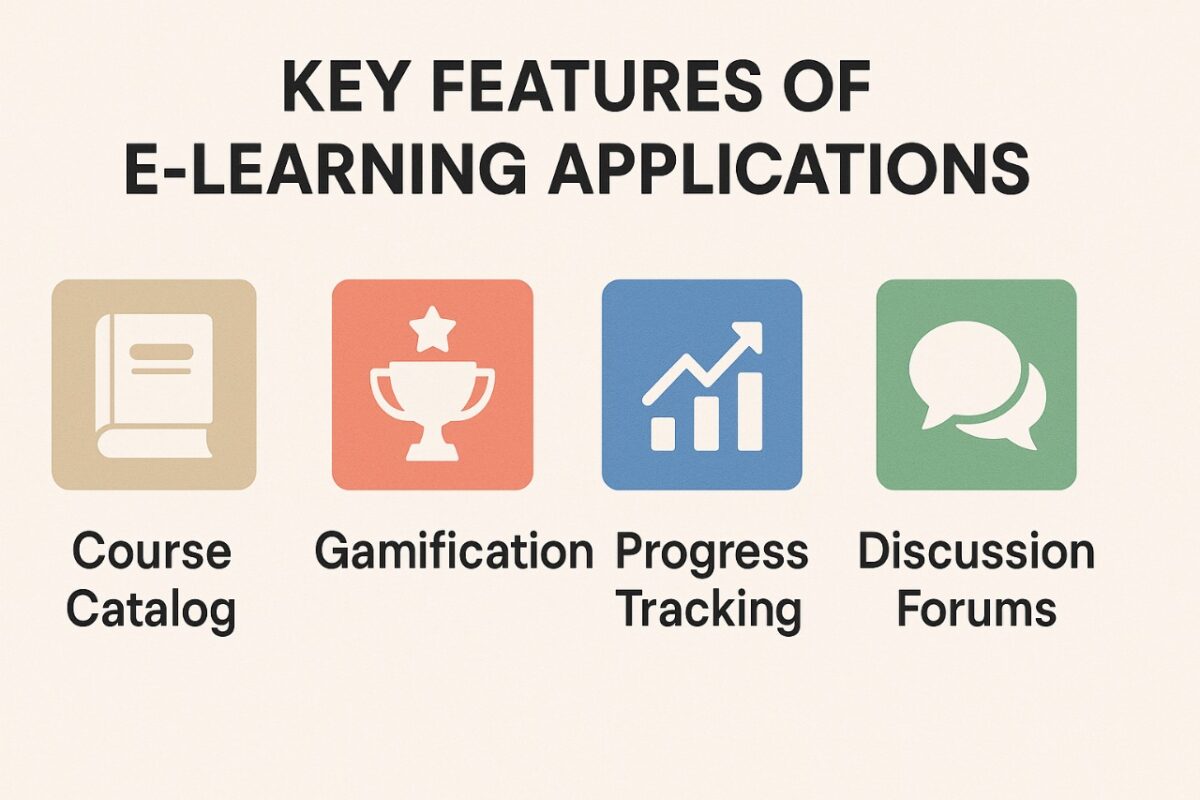
Key Features of E-Learning Applications
1. User Registration & Profiles
Every e-learning app begins with a seamless registration process that allows students, teachers, and trainers to create personalized profiles. These profiles store essential information such as learning history, enrolled courses, progress reports, certificates earned, payment history, and saved content. For teachers, profiles include course creation tools, student management options, and performance analytics. A strong profile system helps personalize learning pathways, recommend suitable courses, and maintain continuity across devices. It also builds a sense of ownership and identity within the platform.
2. Interactive Learning Modules
Interactive modules are the heart of e-learning apps, turning traditional lessons into engaging experiences. These may include video lectures, audio lessons, animations, 3D models, AR/VR environments, digital textbooks, and interactive quizzes. Such formats make complex concepts easier to understand and help learners retain information longer. Whether it’s watching an animation for a science chapter or solving drag-and-drop exercises in math, interactive modules keep learners motivated and deeply involved.
3. Live Classes & Virtual Classrooms
Live classes offer real-time teaching, making online learning feel more personal and classroom-like. Virtual classroom features include live chat, high-quality video streaming, digital whiteboards, screen sharing, and breakout rooms for group discussions. Teachers can conduct doubt-clearing sessions, give instant feedback, and interact with students just like in a physical classroom. These live features are essential for coaching centers, schools, universities, and any platform offering instructor-led training.
4. Assignments, Tests & Assessments
Evaluating a learner’s understanding is a crucial part of any educational system. E-learning apps provide tools for quizzes, subjective assignments, MCQs, practical tasks, coding challenges, and mock exams. Automated grading systems ensure quick feedback, while detailed result analytics help students identify their strengths and weaknesses. Teachers can customize assessments, set time limits, upload rubrics, and monitor performance, creating a complete digital evaluation ecosystem.
5. Progress Tracking & Analytics
One of the most powerful advantages of e-learning is the ability to track progress in real time. Detailed analytics show course completion percentage, time spent on lessons, scores, improvement rate, and topic-wise performance. Students can understand how they are progressing and adjust their learning speed accordingly. Teachers and institutions receive deeper insights into class performance, attendance rates, difficulty areas, and content effectiveness. These data-driven insights help optimize teaching strategies and improve learning outcomes.
6. Gamification Elements
Gamification adds motivation, fun, and a competitive spirit to learning. Features like badges, achievements, levels, leaderboards, points, and learning streaks encourage students to stay consistent. Gamified elements help reduce study fatigue, especially for younger learners or long-term courses. They also create a sense of accomplishment that keeps learners engaged and encourages them to return to the platform daily, significantly boosting course completion rates.
7. Multi-Device Compatibility
E-learning apps must work seamlessly across mobile phones, tablets, laptops, and desktops. Multi-device compatibility ensures that students can switch between devices without losing progress. A learner may start a lesson on their phone while traveling, continue on a laptop at home, and revise on a tablet later. Responsive design, cloud synchronization, and cross-platform accessibility make learning convenient and flexible for all types of users.
8. Offline Mode
Offline learning is essential for users with limited or unstable internet connectivity. This feature allows students to download videos, notes, quizzes, and assignments for offline access. Offline mode ensures uninterrupted learning and expands the reach of e-learning apps to rural areas, travelers, or students with low bandwidth. It also enhances user satisfaction by providing flexibility beyond internet limitations.
9. Discussion Forums & Community Learning
Community learning builds collaboration and peer support. Discussion forums allow students to ask questions, interact with peers, share knowledge, and participate in topic-based conversations. Study groups, community challenges, mentorship programs, and Q&A sections create a sense of belonging. This two-way interaction increases student engagement and provides a platform for exchanging diverse perspectives—something traditional self-study cannot offer.
10. Secure Payments & Subscription Plans
For monetized e-learning platforms, secure payment integration is critical. Payment gateways such as UPI, credit/debit cards, wallets, and net banking allow users to purchase courses, subscribe to premium plans, or register for certifications. Features like auto-renewal, invoices, EMI options, and discount coupons enhance the user experience. Advanced security protocols, encryption, and fraud detection ensure financial safety while building trust among users.
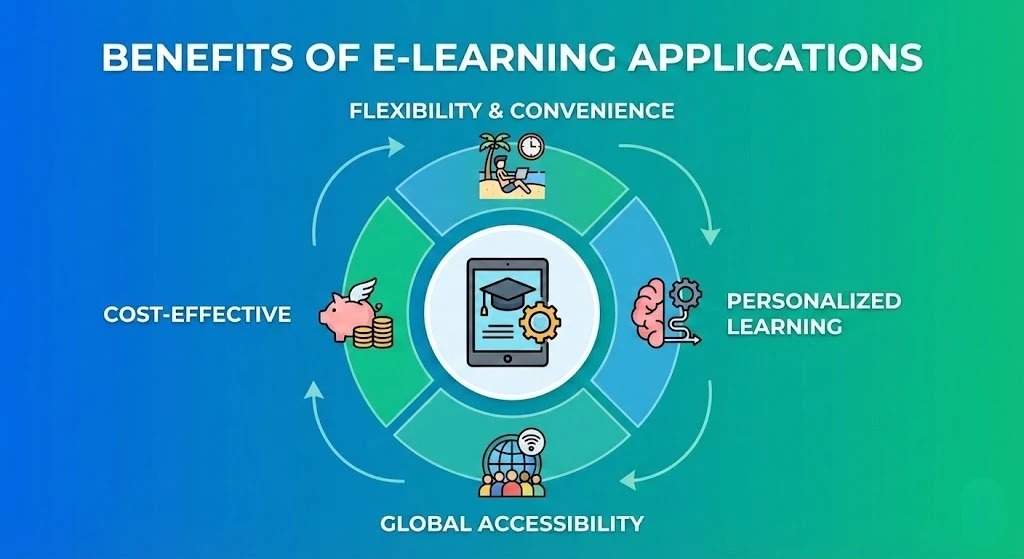
Benefits of E-Learning Applications
1. Learning Anytime, Anywhere
One of the greatest advantages of e-learning applications is the flexibility they provide. Students can access lessons from their home, workplace, or even while traveling. Instead of being restricted by fixed class schedules, learners can study at their own pace and convenience. This makes education accessible for working professionals, busy parents, and students in remote areas who may not have access to quality coaching or institutions. The ability to learn anytime, anywhere ensures uninterrupted learning and empowers users to manage both personal and academic responsibilities with ease.
2. Personalized Learning Experience
E-learning platforms use AI and machine learning algorithms to understand each learner’s behavior, performance, and preferences. Based on this data, the app recommends courses, difficulty levels, practice questions, and revision schedules tailored to individual needs. This customization ensures that fast learners can move quickly, while those who need more time can revisit concepts without pressure. Personalized learning improves academic outcomes, boosts confidence, and ensures that each learner gets a unique, optimized learning journey.
3. Cost-Effective Education
Traditional education involves substantial expenses such as tuition fees, textbooks, travel costs, uniforms, and physical infrastructure maintenance. E-learning eliminates many of these costs by delivering content digitally. Learning materials like ebooks, video lectures, digital notes, and mock tests are available at a fraction of the cost. Many platforms even offer free or affordable subscription models. This cost-effectiveness helps students from all backgrounds access high-quality education without financial strain, making learning more inclusive and affordable.
4. Better Engagement Through Interactivity
E-learning apps enhance engagement through multimedia and interactive features such as animations, videos, quizzes, puzzles, simulations, and gamified lessons. These elements make learning more interesting compared to traditional chalk-and-talk teaching. When students are actively involved in lessons, they retain information better and show greater interest in completing courses. Interactive content caters especially well to young learners and visual/auditory learners, making complex topics easier to understand.
5. Scalability for Institutions & Companies
Unlike traditional classroom setups that require physical space, e-learning platforms can scale effortlessly. Whether teaching 100 or 100,000 learners, digital platforms can serve global audiences without investing in new classrooms, faculty, or infrastructure. Educational institutions, coaching centers, and companies can expand their reach internationally, offering the same quality of content to learners across the world. This scalability makes e-learning the perfect solution for large organizations and EdTech businesses looking to grow rapidly.
6. Access to Global Courses & Instructors
E-learning breaks geographical barriers by giving learners access to world-class educators, universities, and industry experts. Through apps like Coursera, Udemy, edX, and LinkedIn Learning, anyone can learn subjects taught at Harvard, MIT, Stanford, and other global institutions. Students in rural areas or developing regions can now master advanced topics like AI, cloud computing, data science, and foreign languages from top experts. This global access enhances knowledge quality and opens new career opportunities that were once limited by location.
7. Real-Time Performance Tracking
E-learning apps offer detailed analytics dashboards that track every learner’s progress. Students can instantly see their test scores, improvement areas, completion percentages, and study time. Teachers and trainers also benefit from real-time insights, helping them understand class performance, identify struggling students, and customize teaching methods accordingly. For organizations, this tracking helps measure employee training effectiveness. Real-time data makes learning more transparent, result-oriented, and measurable.
Challenges of E-Learning Applications
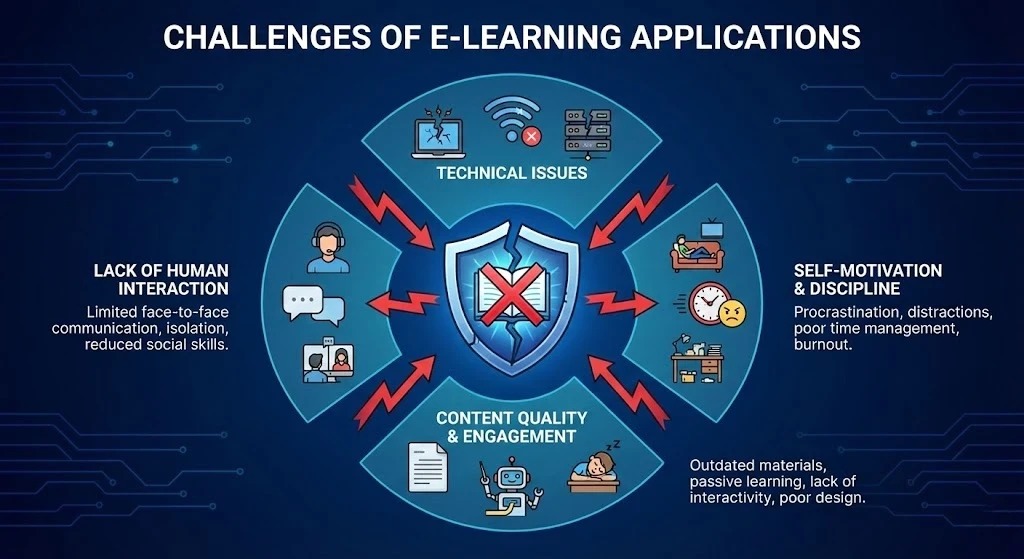
While e-learning has transformed modern education, it also comes with several challenges that developers, institutions, and learners must address. These challenges create hurdles in ensuring smooth, effective, and inclusive learning experiences.
1. Lack of Personal Interaction & Emotional Connection
One of the biggest limitations of e-learning is the absence of face-to-face interaction between students and teachers. Traditional classrooms allow real-time emotional communication, immediate doubt-solving, and stronger teacher-student bonding. In digital platforms, learners often feel isolated, especially young children who thrive on human interaction. This disconnect can affect motivation, engagement, and social skill development.
2. Technical Issues & Internet Dependency
E-learning heavily depends on stable internet connections, updated devices, and technical know-how. Students in rural areas or low-income households often face challenges like slow Wi-Fi, outdated phones, or frequent app crashes. Even small technical difficulties — buffering videos, audio delays, or login errors — can disrupt learning flow and reduce productivity. This digital divide limits the accessibility of online education.
3. Low Attention Span & Distractions
Digital platforms expose learners to distractions like social media, notifications, games, and background noise. Long screen time also contributes to fatigue, reducing attention span and decreasing the effectiveness of learning. Without classroom discipline, learners must rely on self-control and time management skills, which many struggle with.
4. Limited Hands-On or Practical Learning
Certain subjects — such as science labs, engineering workshops, medical training, or arts — require hands-on practice. E-learning platforms often cannot replicate real-world environments completely. Although simulations exist, they are not always a perfect substitute for physical experiments or practical exposure.
5. Content Quality Inconsistency
E-learning content can vary widely across platforms. Some apps offer high-quality lessons created by qualified professionals, while others rely on generic videos lacking depth or structure. Without standardized guidelines, learners may receive incomplete or outdated information, impacting learning outcomes.
6. Data Privacy & Cybersecurity Concerns
E-learning platforms store sensitive information such as user profiles, payment details, performance analytics, and personal data. Without strong encryption and cybersecurity measures, these apps may face risks of hacking, data breaches, or identity theft. Ensuring privacy compliance is a critical challenge for EdTech companies.
7. Over-Reliance on Technology
Students who depend heavily on digital tools may develop weaker problem-solving ability, critical thinking, and independent creativity. Overuse of devices may also lead to health issues like eye strain, poor posture, headaches, or sleep disruption.
Future of E-Learning (AI, AR/VR, Metaverse)
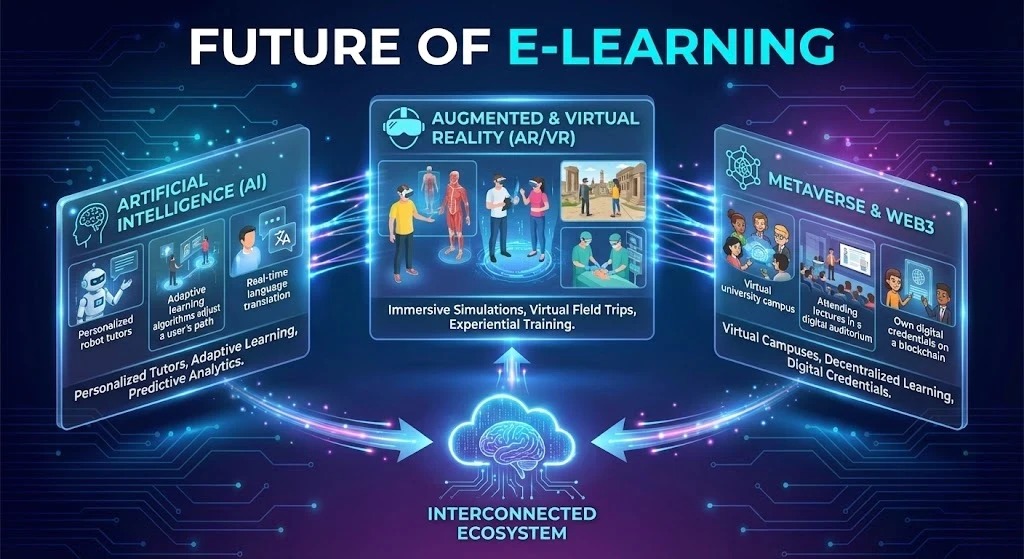
The future of e-learning is evolving rapidly with advanced technologies that promise immersive, intelligent, and personalized education. Below are the major technologies shaping the next generation of learning:
1. Artificial Intelligence (AI) in E-Learning
AI is redefining education by making learning smarter, faster, and more adaptive. AI-based systems can personalize content according to each learner’s pace, strengths, and weaknesses. Intelligent chatbots provide 24/7 support, answering questions instantly. AI-powered analytics help teachers identify learning gaps and recommend targeted practice. From automated grading to emotion-based learning (detecting student mood via cameras), AI is making education more efficient and deeply personalized.
2. Augmented Reality (AR) for Interactive Learning
AR overlays digital elements on real-world objects, allowing students to learn by visualizing concepts in 3D. For example:
Medical students can study human anatomy through AR organs.
Engineering students can visualize machines and circuits.
School kids can see planets, cells, and historical events come to life.
This interactive learning boosts understanding, makes complex topics easier, and increases engagement.
3. Virtual Reality (VR) for Immersive Experiences
VR creates fully simulated environments that transport learners into virtual worlds. With VR headsets, students can experience:
Virtual science labs
Historical recreations
Virtual field trips
Flight and surgery simulations
This is especially impactful for fields requiring hands-on practice, offering safe, realistic environments for training.
4. Metaverse-Based Education
The Metaverse is the next frontier for e-learning. It combines VR, AR, AI, and 3D environments to create virtual campuses where students can attend classes as avatars. In metaverse classrooms, learners can interact with peers, explore virtual labs, participate in simulations, and collaborate in real-time. It brings social learning back into digital education, making remote learning feel more interactive and community-driven.
5. Gamification & Learning Psychology
Future e-learning apps will use advanced gamification techniques inspired by video game psychology — rewards, missions, leaderboards, and adaptive difficulty levels. This ensures learning becomes addictive, motivating, and highly engaging for all age groups.
6. Voice-Based & Hands-Free Learning
Voice assistants and speech-recognition technologies will enable learners to take quizzes, ask questions, or navigate lessons without touching the screen. This is especially beneficial for visually impaired students or users multitasking during lessons.
7. Hyper-Personalized Learning with Big Data
Using large-scale analytics, e-learning systems will predict learning behavior, recommend ideal study times, and adapt lesson difficulty automatically. This ensures optimized learning outcomes for each individual.
Conclusion
E-learning applications have revolutionized modern education by bringing flexibility, accessibility, and innovation to the learning process. From interactive video lessons to AI-driven personalization and immersive AR/VR experiences, digital learning platforms offer powerful tools that enhance comprehension and engagement. They break geographical and financial barriers, making high-quality education available to anyone with an internet connection.
However, like any technology, e-learning comes with challenges such as technical limitations, reduced emotional interaction, and content inconsistencies. Addressing these issues is essential to ensure an inclusive and effective learning ecosystem. With advancements in artificial intelligence, augmented reality, virtual reality, and the Metaverse, the future of e-learning promises a more immersive, adaptive, and personalized educational experience than ever before.
As digital transformation continues to accelerate, e-learning applications will play an even more significant role in shaping the future of schools, universities, corporates, and professional training worldwide. For institutions, educators, and learners, embracing this evolution is not just an advantage—it is a necessity for long-term growth, skill development, and global competitiveness.
Contact Us
We at ITech Solutions are always here to help you bring your ideas to life. Whether you have questions about our services or want to start a new project, we are ready to assist you with expert guidance and support.
Email: hr@itechs.co.in
Phone: +91-7976833560