

What Are AI Chatbot App Development Services?
AI chatbot app development services involve creating intelligent conversational applications that can communicate with users in natural language through text or voice. These chatbots use AI, machine learning (ML), natural language processing (NLP), and deep learning to understand queries, learn from past interactions, and provide accurate responses.
Professional chatbot development companies build:
- Customer support bots
- E-commerce chatbots
- Healthcare assistants
- Travel support bots
- Banking & fintech chatbots
- Educational AI tutors
- Virtual personal assistants
- Task automation bots
These bots can be integrated into mobile apps, websites, social media platforms, messaging apps like WhatsApp, Facebook Messenger, Slack, or even IoT devices.
Why Businesses Need AI Chatbot App Development
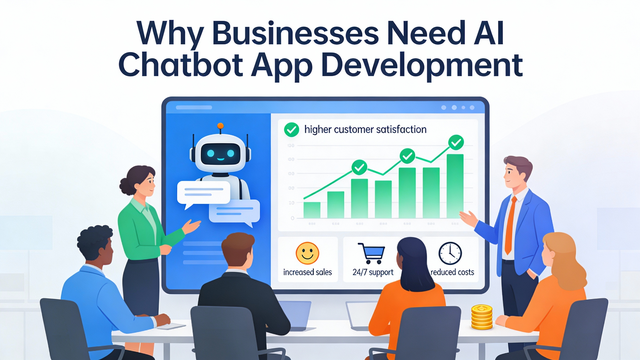
AI chatbots have become indispensable because they:
1. Automate Customer Service
One of the biggest reasons businesses need AI chatbot app development is the ability to automate customer service on a 24/7 basis. Traditional customer support relies heavily on human agents, which results in long waiting times, limited availability, and high staffing costs. AI chatbots solve this problem by providing instant responses around the clock, handling thousands of queries simultaneously without delays. They instantly answer FAQs, track orders, resolve complaints, schedule appointments, and guide users through various processes. This automation improves service speed dramatically, enhances overall customer satisfaction, and ensures that no customer inquiry remains unanswered even during peak hours or non-working days.
2. Reduce Operational Costs
Hiring and training human support agents is expensive, especially for businesses handling high volumes of customer interactions. AI chatbots help companies reduce operational expenses by automating repetitive tasks and minimizing dependency on large support teams. A well-developed chatbot can handle up to 70–80% of standard queries without human intervention, allowing businesses to allocate human resources only for complex cases. This leads to lower salary costs, reduced infrastructure expenses, and overall improvement in cost-efficiency. Additionally, chatbots eliminate the need for call centers, large help desks, and physical support operations—making them a valuable asset for cost-conscious businesses.
3. Offer Personalized User Experience
Modern customers expect personalized experiences every time they interact with a brand. An AI chatbot app uses advanced technologies such as machine learning, natural language processing (NLP), and user analytics to understand customer behavior, preferences, interests, and past interactions. Based on this data, the chatbot delivers highly relevant recommendations—whether it’s suggesting a product, reminding users about cart items, offering customized solutions, or providing tailored support responses. This personalization creates a more engaging and satisfying experience, increases customer loyalty, and strengthens brand relationships. In many cases, AI chatbots even adapt their tone and conversation style based on the user’s communication behavior.
4. Increase Customer Engagement
Engagement is crucial for retaining customers in today’s competitive market. AI chatbots act as real-time digital assistants that keep users engaged through interactive conversations. They initiate personalized messages, push reminders, share product updates, recommend new features, and even provide entertainment through quizzes or conversational interactions. By staying available at every point of the user journey—whether it’s pre-purchase inquiries, post-purchase support, or follow-up communication—chatbots keep customers active and involved. Higher engagement leads to better brand recall, more frequent interactions, and increased customer satisfaction.
5. Improve Conversion Rates
AI chatbots serve as virtual sales assistants that guide users through the decision-making process. They answer questions instantly, clarify doubts, recommend products, and assist with checkout steps. By reducing friction during the buying journey, chatbots significantly increase conversion rates. They also perform follow-ups, send cart reminders, provide discount codes, and offer real-time assistance during purchases. This automated support helps reduce drop-offs and boosts overall sales and revenue for businesses.
Types of AI Chatbots a Development Company Can Build
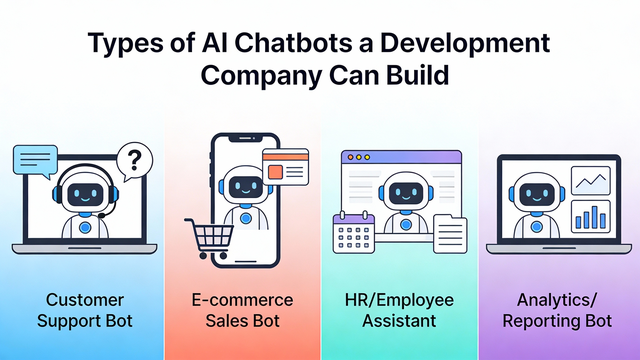
1. Rule-Based Chatbots
Rule-based chatbots operate using predefined rules, decision trees, and keyword-based triggers. They guide users through structured flows, where each question leads to a limited number of predetermined responses. These chatbots are ideal for simple FAQ handling, appointment booking, basic queries, and lead qualification. A development company designs these bots to follow step-by-step logic, ensuring accuracy and consistency in responses. Although they lack advanced conversational abilities, rule-based chatbots are cost-effective, easy to deploy, and highly reliable for predictable user interactions.
2. AI-Powered Conversational Chatbots
AI conversational chatbots use Natural Language Processing (NLP), Natural Language Understanding (NLU), and Machine Learning (ML) to understand human language, interpret intent, and respond in a human-like manner. These bots learn from user behavior, adapt to new questions, and become smarter with every interaction. They can understand slang, context, sentiment, and complex queries. A development company builds such chatbots for businesses that need advanced customer support, intelligent recommendations, sales assistance, or multi-turn conversations. These bots create engaging experiences that closely resemble real human communication.
3. Voice-Based Chatbots / Voice Assistants
Voice-based chatbots combine speech recognition, voice-to-text, and AI-powered processing to enable hands-free communication. These chatbots can be integrated into mobile apps, websites, smart home devices, IVR systems, and wearable technology. Users simply speak their queries, and the bot provides spoken or visual responses. Voice assistants are particularly useful for accessibility, multitasking, and industries such as automotive, healthcare, fitness, and customer service. Development companies ensure these bots provide fast, accurate voice responses with minimal errors—even in noisy environments.
4. Contextual Chatbots
Contextual chatbots are among the most advanced types, capable of remembering past interactions, user preferences, behavior patterns, and previous data inputs. They provide context-aware responses by analyzing conversation history and user identity, making interactions more personalized and meaningful. For example, a contextual bot may recommend products based on previous purchases or continue a conversation from where the user left off. Businesses use these bots for high-level support, personalized shopping assistance, and long-term customer engagement.
5. Ecommerce Chatbots
Ecommerce chatbots help businesses enhance shopping experiences by offering real-time assistance. These bots guide customers through product discovery, personalized recommendations, discount suggestions, cart recovery messages, and instant answers to product-related queries. They also support order tracking, return requests, and payment-related questions. Ecommerce businesses use these chatbots to reduce abandoned carts, increase sales conversions, and provide 24/7 customer support. A development company builds these bots to be CRM-friendly and capable of integrating with platforms like Shopify, WooCommerce, Magento, and others.
6. Healthcare Chatbots
Healthcare chatbots assist hospitals, clinics, and telemedicine platforms by offering symptom analysis, appointment scheduling, medication reminders, and general medical guidance. They can triage patients, provide condition-based suggestions, and direct users to the appropriate department or specialist. These bots significantly reduce administrative workload, improve patient engagement, and support efficient healthcare delivery. Development companies ensure healthcare chatbots are HIPAA-compliant, secure, and capable of handling sensitive patient data responsibly.
7. Enterprise Workflow Chatbots
Enterprise chatbots automate internal business workflows such as HR assistance, employee onboarding, payroll queries, IT support tickets, asset management, and internal communication. Employees can use these bots to request leaves, submit issues, track project updates, and access company policies instantly. These bots help organizations boost productivity, reduce repetitive workload, and simplify digital operations. AI chatbot development companies build these bots with integration capabilities for ERP, CRM, HRMS, and ticketing systems.
8. Social Media Chatbots
Social media chatbots are built for platforms such as WhatsApp, Instagram, Facebook Messenger, Telegram, Slack, and more. They are designed to engage followers, automate customer service, generate leads, handle inquiries, manage bookings, and support marketing campaigns. Businesses leverage these bots to stay active on multiple channels while offering instant responses to potential customers. Development companies ensure seamless API integration and compliance with each platform’s guidelines to create powerful omnichannel messaging experiences.
Key Features of an AI Chatbot Application
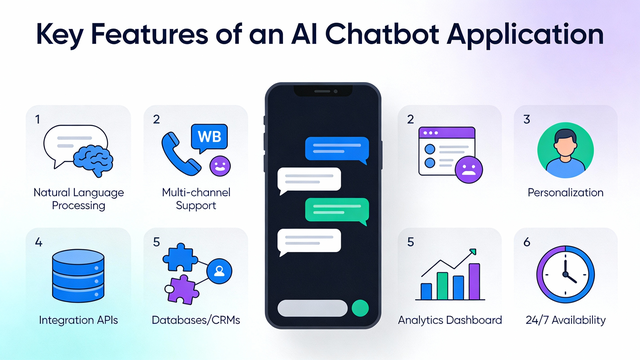
1. Natural Language Processing (NLP)
Natural Language Processing is the backbone of any advanced chatbot. It allows the system to understand human language in all its complexities—grammar, intent, slang, emotions, and context. Instead of relying on keyword-based detection, NLP enables chatbots to interpret what users mean, not just what they type. It also helps the bot manage spelling mistakes, short queries, long sentences, and conversational tone. With NLP, chatbots can deliver meaningful, accurate, and human-like responses, improving customer satisfaction and creating natural communication flows that feel effortless for users.
2. Multilingual Support
Global businesses require chatbots that can communicate with users in their preferred language. Multilingual support empowers an AI chatbot to understand and reply in multiple languages, including regional dialects and culturally specific expressions. This feature increases accessibility, helps companies enter new markets, and builds trust with diverse audiences. With AI-powered translation engines, the chatbot can seamlessly switch between languages in real time, enabling businesses to offer 24/7 support across different countries without hiring additional multilingual staff.
3. Voice & Text Interaction
AI chatbots are not just automated responders—they are intelligent systems capable of analyzing user preferences, past interactions, purchase behavior, browsing history, and even sentiment. Based on this data, chatbots offer personalized recommendations such as product suggestions, service upgrades, tailored offers, and relevant content. Personalized communication boosts customer loyalty and increases the chances of conversion. Users feel understood, valued, and supported, which enhances the overall brand experience.
4. Personalization Engine
Personalization is one of the most powerful aspects of AI chatbot technology. Using machine learning, the chatbot studies user behavior, browsing history, previous interactions, preferences, and commonly asked questions. With this data, it tailors responses, offers relevant product recommendations, personalizes greetings, and ensures users feel understood. For example, an ecommerce chatbot might suggest products based on past purchases, while a healthcare bot may remember symptoms previously discussed. Personalization boosts engagement, builds trust, and increases conversion rates by delivering experiences that feel uniquely customized.
5. Integration Capabilities
A high-performance AI chatbot does not work in isolation; it connects with multiple internal and external systems to provide seamless service. Professional chatbot applications integrate with CRMs (like Salesforce, HubSpot), ERPs, payment gateways, databases, marketing automation tools, social media platforms, and eCommerce systems. This allows the bot to fetch order details, update records, track tickets, process payments, check inventory, book appointments, or send notifications automatically. Strong integration capabilities turn the chatbot into a central intelligence hub that automates workflows across the entire business ecosystem.
6. Emotion & Sentiment Analysis
Emotion and sentiment analysis enable the chatbot to understand how the user feels during the conversation. By analyzing tone, choice of words, punctuation, and context, the chatbot can detect emotions such as frustration, happiness, confusion, or urgency. This helps it respond with empathy, adjust its tone, and escalate sensitive issues to a human agent when needed. For example, if a customer expresses frustration with delayed delivery, the chatbot can instantly apologize, offer solutions, or hand over the chat to a support agent. This emotional intelligence creates more meaningful and human-like conversations.
7. Analytics Dashboard
An analytics dashboard is essential for business owners, allowing them to track chatbot performance and make data-driven improvements. It provides detailed insights into user behavior, popular queries, conversation drop-offs, satisfaction scores, response accuracy, and conversion rates. Businesses can analyze chat volume, session duration, peak hours, user demographics, and bot efficiency. These metrics help companies identify areas where the bot needs improvement, refine training data, and optimize the customer experience. Over time, analytics dashboards help businesses boost performance and achieve higher ROI from their chatbot investment.
8. Human Handoff System
Despite being powerful, AI chatbots cannot solve every complex issue. This is where the human handoff system becomes essential. When the chatbot detects that a query requires human expertise—such as complaints, emotional distress, or technical complications—it automatically transfers the conversation to a live agent. The transfer happens smoothly, with full context and chat history passed to the human representative so the user doesn’t have to repeat themselves. This ensures uninterrupted service, prevents frustration, and maintains a high quality of support.
9. Secure Authentication
Security is a top priority for chatbot applications, especially when handling sensitive customer information. Secure authentication includes features like role-based access control, encrypted conversations, API security, and two-factor authentication (2FA). These security layers prevent unauthorized access, protect personal data, and ensure safe transactions. For industries like finance, healthcare, government, and ecommerce, secure authentication is absolutely essential. A professionally built AI chatbot ensures compliance with industry standards such as GDPR, HIPAA, and ISO security norms, giving users complete confidence while interacting.
AI Chatbot App Development Services Offered
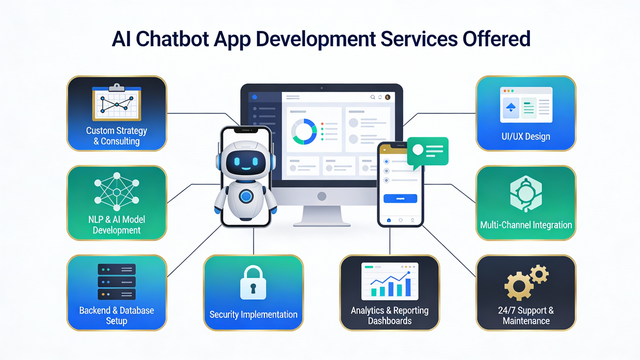
1. Custom Chatbot Design & Development
Custom chatbot development begins with understanding the client’s specific business goals, customer needs, communication style, and workflow structure. Developers create fully personalized chatbots that match the brand’s voice, tone, and purpose—whether the bot is meant for customer support, sales, lead generation, healthcare assistance, or internal enterprise communication. The development team carefully designs conversation flows, user journeys, and response patterns to make interactions smooth and human-like. They also ensure the chatbot can handle multiple query types, support various user scenarios, and deliver consistent, accurate answers. This customized approach ensures maximum effectiveness and aligns the chatbot’s functionality perfectly with business objectives.
2. Chatbot Training & NLP Model Building
AI chatbots require training to understand user queries accurately. Development companies build and fine-tune NLP (Natural Language Processing) models using domain-specific datasets. These datasets may include FAQs, customer support transcripts, product catalogs, user queries, or industry-related terminology. Through continuous training sessions, the chatbot learns user intent, context, synonyms, sentence variations, and tone differences. Machine learning algorithms refine responses over time, making the chatbot smarter, more natural, and more efficient with every interaction. This process ensures that the bot can handle complex questions, ambiguities, and conversation branching with high accuracy.
3. Integration With Existing Systems
For a chatbot to maximize its potential, it must connect seamlessly with the company’s existing digital ecosystem. Development companies integrate chatbots with CRM systems (Salesforce, HubSpot, Zoho), ERP platforms (SAP, Oracle, Odoo), support ticketing systems (Freshdesk, Zendesk), websites, mobile apps, emails, databases, payment gateways, and marketing tools. This allows the chatbot to fetch real-time information such as order status, user history, product inventory, account details, and personalized recommendations. With deep integration, chatbots can perform tasks like placing orders, generating tickets, updating CRM records, and processing payments—making them significantly more useful and powerful.
4. WhatsApp & Social Media Bot Development
Businesses are increasingly adopting messaging platforms such as WhatsApp, Instagram, Facebook Messenger, Telegram, and Viber to interact with customers. AI development companies build high-converting chatbots for these platforms, enabling automated customer support, lead generation, appointment booking, product recommendations, reminders, and promotional broadcasts. These bots follow the guidelines of each platform (such as WhatsApp Cloud API rules) and ensure a seamless user experience. Social media chatbots help businesses stay active 24/7, respond instantly, and significantly reduce human effort in managing repetitive conversations across channels.
5. Voice Assistant Development
Voice-enabled chatbots offer hands-free convenience and are ideal for mobile apps, websites, smart devices, wearables, and IoT environments. Development companies create voice assistants similar to Alexa, Siri, or Google Assistant using advanced speech recognition and text-to-speech technologies. These voice bots can understand natural speech, respond with conversational accuracy, execute voice commands, and assist users with tasks such as scheduling, navigation, order tracking, customer support, and data retrieval. Voice bots enhance accessibility and provide a modern, frictionless interaction experience for users across devices.
6. AI Chatbot Maintenance & Optimization
AI chatbots require ongoing improvements to stay accurate, relevant, and efficient. Companies offer long-term maintenance services that include continuous NLP training, updating bot responses, analyzing user intent, improving algorithms, fixing performance issues, and monitoring conversation quality. Regular updates help the chatbot adapt to new customer queries, evolving business processes, product catalog changes, and seasonal demands. Performance optimization ensures the bot becomes faster, smarter, and more accurate over time, leading to better customer satisfaction and higher engagement.
7. Conversational Workflow Automation
Chatbots streamline business operations by automating repetitive tasks and communication workflows. Development companies build automated flows for customer support (FAQs, ticket creation, troubleshooting), sales processes (lead qualification, product recommendation, follow-ups), marketing (broadcast messages, discount alerts, coupon distribution), and order management (order tracking, payment reminders, delivery updates). These automated workflows reduce manual work, improve efficiency, and ensure consistent communication across all stages of the customer journey. Automation not only saves time and money but also helps businesses deliver faster and more personalized interactions at scale.
AI Chatbot Development Process
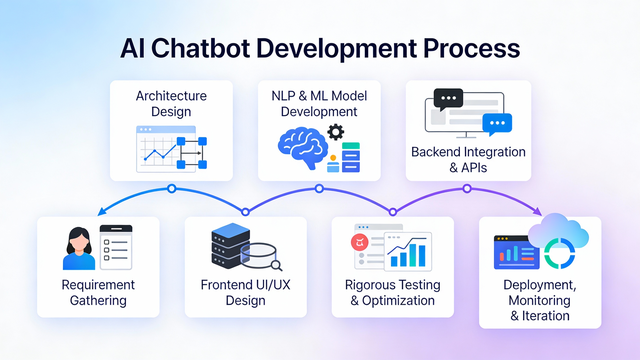
1. Requirement Analysis
The first stage focuses on deeply understanding the business goals, target audience, expected user behavior, and specific problems the chatbot will solve. Developers identify core use cases such as customer support, lead generation, sales assistance, HR automation, or healthcare guidance. This phase also involves analyzing customer pain points, preferred communication channels, and expected conversation volume. The objective is to define the chatbot’s purpose clearly so it can deliver meaningful value rather than generic responses.
2. Chatbot Strategy Planning
Once requirements are clear, the next step is strategic planning. Here, experts outline the scope of the chatbot, the complexity of conversations, key features needed, and the type of AI model to use. Detailed conversation flows are mapped, including how the bot should greet, respond, guide, escalate, and close interactions. This step also covers integration requirements—such as connecting the bot with CRM, ERP, payment systems, websites, mobile apps, or messaging platforms. A complete development roadmap is created with milestones, timelines, and architecture decisions.
3. UI/UX & Chat Flow Design
Chatbots must feel natural, intuitive, and easy for users to interact with. Designers create user-friendly chat interfaces and outline the entire conversational journey. This includes designing quick-reply buttons, fallback responses, suggestions, multi-step forms, and user prompts. At this stage, designers ensure the chatbot’s tone, personality, and communication style matches the brand’s voice—whether formal, friendly, playful, or professional. The goal is to offer a smooth and engaging conversational experience.
4. Natural Language Processing (NLP) Model Setup
This is the technical heart of the chatbot. Developers select or train an NLP model that will interpret user intent, understand natural language, detect emotion, and respond intelligently. Depending on the project, the bot may use pre-trained AI models or completely custom machine-learning models trained on domain-specific datasets. This stage involves building intent classifiers, entity extractors, sentiment analysis, and contextual understanding. Continuous training ensures the chatbot becomes smarter, more accurate, and more conversational over time.
5. Development & Integration
Once the NLP brain is ready, developers start building the backend logic, chatbot engine, APIs, and user interface. Core functionalities like message handling, conversation routing, authentication, personalization, and multi-language support are implemented. The chatbot is then integrated with essential systems such as CRM, ERP, databases, ecommerce platforms, ticketing systems, or messaging tools like WhatsApp and Instagram. At this stage, the bot becomes functional and capable of performing real tasks.
6. Testing & Quality Assurance
Before deployment, the chatbot undergoes rigorous testing to ensure reliability, accuracy, and smooth performance. QA teams check for factors like conversational flow accuracy, response relevance, error handling, and system stability. Stress tests are performed to evaluate how the chatbot performs under high traffic or complex queries. Security testing ensures encrypted communication and protection against unauthorized access. The goal is to eliminate bugs and ensure a flawless user experience.
7. Deployment
Once testing is completed, the chatbot is deployed on the desired platforms—such as a website, mobile app, CRM system, WhatsApp, Instagram, Messenger, or a custom enterprise environment. Deployment includes server setup, cloud configuration, approval from platform providers (if needed), and final optimization checks. After launch, the bot becomes live and starts interacting with real users.
8. Ongoing Support & Training
AI chatbots require continuous improvement to stay efficient and accurate. After deployment, developers monitor the bot’s performance, user interactions, and drop-off points. New data is used to retrain and enhance the AI model so responses keep improving. Regular updates, new features, security patches, and language expansions are added over time. This ensures the chatbot evolves with changing business needs and user expectations.
Benefits of AI Chatbot App Development
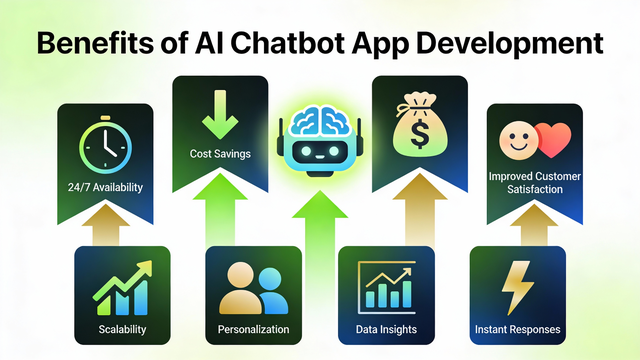
1. 24/7 Customer Support
One of the biggest advantages of AI chatbots is their ability to operate around the clock without breaks or downtime. Customers can get help at any hour of the day—whether it’s a simple question, product inquiry, or troubleshooting request. This ensures users never feel ignored or forced to wait for business hours, significantly boosting customer satisfaction. A chatbot ensures consistent service delivery, reduces response delays, and creates a reliable support environment where customers feel valued and heard at all times.
2. Reduced Operational Costs
One of the biggest advantages of AI chatbots is their ability to operate around the clock without breaks or downtime. Customers can get help at any hour of the day—whether it’s a simple question, product inquiry, or troubleshooting request. This ensures users never feel ignored or forced to wait for business hours, significantly boosting customer satisfaction. A chatbot ensures consistent service delivery, reduces response delays, and creates a reliable support environment where customers feel valued and heard at all times.
3. Higher Conversion Rates
AI chatbots play a major role in improving customer purchasing decisions. They proactively assist users by suggesting relevant products, explaining features, addressing objections, and guiding them step-by-step through the buying process. This instant support removes hesitation and confusion, resulting in faster decisions and increased sales. For eCommerce websites, chatbots help recover abandoned carts, offer promotional codes, and remind users about pending purchases, significantly boosting conversion rates.
4. Personalized Customer Interaction
Modern AI chatbots are capable of analyzing user preferences, past interactions, browsing history, and behavioral patterns to deliver highly personalized experiences. Instead of generic responses, chatbots provide tailored recommendations that align with individual user needs. This level of personalization increases engagement, builds trust, and enhances customer loyalty. Personalized conversations also make users feel understood and valued, which strengthens brand relationships over time.
5. Faster Issue Resolution
Traditional customer support systems often involve long wait times, complicated IVR menus, or delayed email responses. AI chatbots eliminate these pain points by offering immediate assistance. They can quickly access databases, retrieve account information, process simple requests, and resolve common issues within seconds. This rapid problem-solving ability leads to happier customers, fewer escalations, and smoother support operations. When an issue requires human intervention, chatbots ensure a seamless handoff without losing context.
6. Scalability
Human teams cannot handle thousands of customer conversations at the same time, especially during peak hours or seasonal spikes. AI chatbots, however, can manage unlimited users simultaneously without compromising quality. Whether 10 users or 10,000 users ask questions at the same time, chatbots respond instantly and efficiently. This makes them an invaluable asset for growing businesses that need scalable customer support and sales automation without expanding manpower.
7. Improved Productivity
By taking over repetitive and time-consuming tasks, AI chatbots free employees to focus on more strategic, revenue-generating, or complex responsibilities. Instead of answering the same queries repeatedly, human agents can handle high-value tasks such as customer retention, dispute resolution, product improvements, or personalized consultations. This shift not only boosts productivity but also enhances employee satisfaction and operational efficiency across departments.
Challenges in AI Chatbot Development
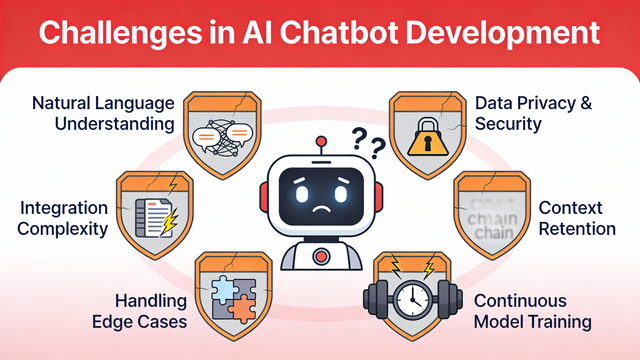
1. Understanding Complex Human Intent
One of the biggest obstacles in chatbot development is helping the system understand the complexity and unpredictability of human language. People express the same question in hundreds of different ways, using slang, abbreviations, mixed languages (Hinglish, Spanglish), sarcasm, or incomplete sentences. A chatbot must interpret the true intent behind each message rather than relying only on keywords. This requires extensive training, large datasets, and advanced NLP models that can learn context, variations, and hidden meaning. Without deep training and continuous learning, the bot may respond incorrectly, leading to user frustration and reduced trust.
2. Data Privacy Concerns
AI chatbots often handle sensitive user information such as names, emails, phone numbers, purchase histories, payment data, health details, or personal preferences. Ensuring that this data is stored securely and processed according to privacy regulations (GDPR, HIPAA, CCPA) is a major challenge. Developers must build strong encryption, access control, secure authentication, and safe data-transfer protocols. Any breach or misuse can damage brand reputation and lead to legal consequences. Maintaining proper data privacy becomes even more complex when the chatbot integrates with third-party systems or cloud platforms.
3. Integration With Legacy Systems
Many businesses still operate using outdated software systems that were not built to connect with modern AI applications. Integrating a chatbot with legacy CRMs, ERPs, ticketing systems, or databases may require customized APIs or middleware solutions. This process can be time-consuming, technically challenging, and expensive. Compatibility issues, inconsistent data formats, and limited documentation can slow down development. To ensure seamless operation, developers must carefully plan the integration architecture and test the system thoroughly.
4. Poorly-Trained Bots
The quality of an AI chatbot depends heavily on the quality of the training data. If the bot is trained on incomplete, outdated, or irrelevant datasets, it will generate inaccurate or unhelpful responses. Poorly trained bots often repeat the same answers, fail to understand user queries, or respond with irrelevant information. This negatively affects user experience and causes customers to lose trust in the system. Continuous training, real-time feedback loops, and domain-specific datasets are essential to improve the chatbot’s accuracy, reliability, and conversational fluency.
5. Miscommunication & Errors
Despite advancements in NLP, chatbots may still struggle with slang, humor, emotional statements, sarcasm, complex instructions, or ambiguous questions. Miscommunication can occur when the bot misinterprets the meaning or context of a message. For example, a sarcastic comment or a metaphor might confuse the system, resulting in an inappropriate or incorrect response. Developers must incorporate sentiment analysis, emotion detection, and fallback responses to minimize misunderstandings. Even with these systems in place, handling all linguistic nuances remains a major challenge in chatbot development.
Future Trends in AI Chatbots
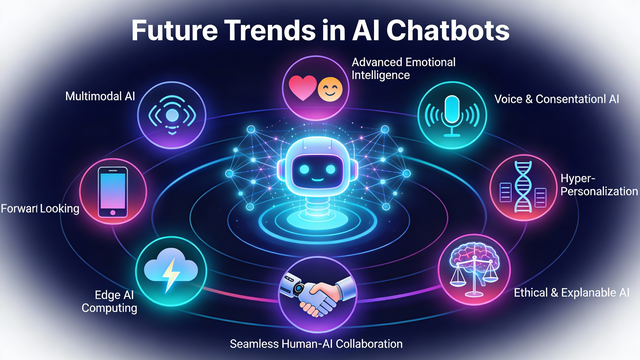
1. Emotionally Intelligent Chatbots
The future of AI lies in emotional understanding, and chatbots will soon be capable of interpreting subtle human emotions with high accuracy. Using advanced sentiment analysis, tone detection, voice stress analysis, and even facial expression recognition (in multimodal models), these bots will understand whether a user is frustrated, confused, excited, or unhappy. This emotional intelligence will enable them to respond empathetically, adjust communication style, and provide personalized support that feels more human. Brands will benefit from improved customer satisfaction, reduced conflict cases, and deeper user trust.
2. Voice-First Assistants
Voice-based communication is becoming increasingly popular, driven by the rise of Alexa, Siri, and Google Assistant. The next generation of AI chatbots will prioritize voice-first interfaces rather than traditional text interactions. Businesses will integrate chatbots that allow hands-free communication across mobile apps, websites, IoT devices, and wearables. These bots will support natural speech, regional languages, accents, and tone variations. As industries shift toward voice commerce, voice-enabled customer service, and voice-driven productivity tools, voice-first chatbots will become a core part of digital ecosystems.
3. Hyper-Personalization
Future chatbots will deliver deeply personalized experiences based on behavioral patterns, user history, past conversations, browsing habits, purchase data, and engagement levels. Instead of generic responses, bots will recommend products, services, or solutions tailored specifically to each user’s preferences. They will anticipate needs before users express them—similar to predictive AI. Hyper-personalization will transform chatbots into digital companions that can deeply understand user identity and provide suggestions that feel natural, relevant, and intuitive. This will significantly improve conversions and long-term engagement.
4. AI Agents & Autonomous Bots
Chatbots of the future will go beyond answering questions—they will act like autonomous AI agents capable of performing tasks without human instruction. These bots will create tickets, process refunds, schedule appointments, update CRMs, complete transactions, analyze user issues, and resolve them automatically. With advanced reasoning, planning, and decision-making abilities, AI agents will behave more like digital employees. They will reduce workload across support, operations, HR, finance, sales, and IT departments—helping businesses scale effortlessly without hiring large teams.
5. Multimodal Chatbots
Multimodal AI is a significant breakthrough, enabling chatbots to understand images, voice input, documents, PDFs, screenshots, gestures, and video—alongside text. These future chatbots will handle tasks like:
- Reading and analyzing invoices
- Extracting text from images
- Understanding product photos
- Processing customer voice messages
- Reviewing documents for errors
- Watching short clips to detect issues
By supporting multiple input types, multimodal chatbots will serve industries like healthcare, finance, e-commerce, legal, and education more effectively. They will solve queries in minutes that currently take human agents hours.
6. Generative AI Everywhere
Generative AI has already transformed content creation, and future chatbots will integrate it deeply. These bots will create personalized product descriptions, emails, marketing content, summaries, documents, reports, and even graphic designs. For customer service, they will generate intelligent answers that go beyond predefined training data. In e-commerce, generative bots will suggest outfits, create skincare routines, or generate custom diet plans. In enterprise environments, they will prepare presentations, automate documentation, and improve team productivity. This trend will make chatbots significantly more powerful and valuable across all industries.
Conclusion
AI chatbot app development has become a critical investment for modern businesses looking to automate support, enhance customer experience, and scale operations efficiently. With the ability to offer 24/7 assistance, reduce operational costs, deliver personalized interactions, and boost conversions, chatbots are transforming how companies communicate with their customers. As technology continues to advance—with trends like emotional intelligence, multimodal inputs, hyper-personalization, and generative AI—the future of chatbots will be even more powerful, intuitive, and business-driven.
By partnering with a professional AI chatbot development company, businesses can build intelligent, secure, and scalable chatbot solutions that not only meet today’s digital expectations but also prepare them for tomorrow’s AI-powered world.
Contact Us
We at ITech Solutions are always here to help you bring your ideas to life. Whether you have questions about our services or want to start a new project, we are ready to assist you with expert guidance and support.
Email: hr@itechs.co.in
Phone: +91-7976833560